


Mortal Kombat II Looks Exactly Like the Game, So Why Does It Feel Like a Loading Screen?
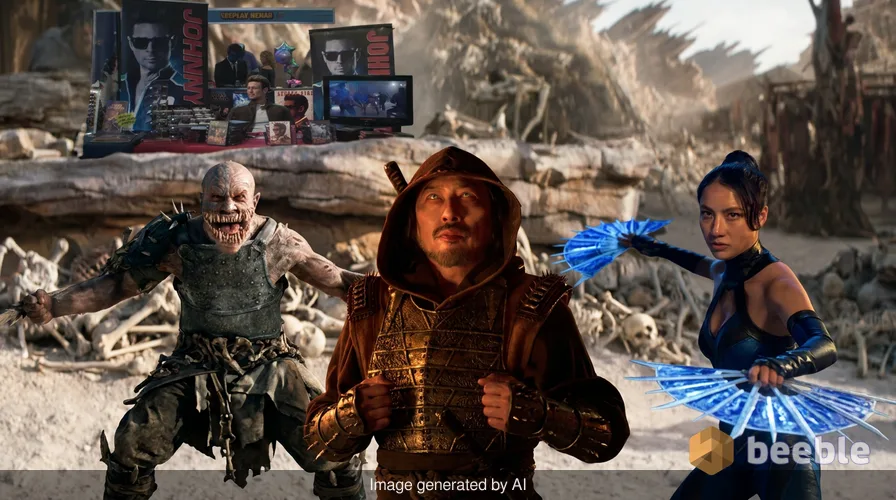
There is a specific, hollow sensation that settles in the chest somewhere around the second-act mark of a modern franchise blockbuster. It is the feeling of being catered to so precisely that the experience ceases to be art and becomes a transaction. You see the screen flicker with the familiar neon glow of the Pit stage; you hear the roar of a crowd that sounds exactly like the 1992 arcade original; you watch Karl Urban lean into a smirk that screams 'Johnny Cage' with every fiber of its being. And yet, the emotional needle barely moves. It is the cinematic equivalent of eating a beautifully decorated cake made entirely of fondant—visually perfect, technically impressive, and ultimately devoid of any real substance.
Behind the scenes, this emptiness is the result of a highly engineered industrial process. We are currently witnessing the aftermath of a decades-long struggle to translate video games to the silver screen, a journey that has moved from the 'so bad it’s good' campiness of the nineties to a sterile, hyper-faithful precision. Paradoxically, as the costumes have become more accurate and the special effects more seamless, the soul of these stories has often become more fragmented. Mortal Kombat II is the latest exhibit in this trend, a film that clears the exceptionally low bar set by its predecessors but fails to ask why the bar was on the floor to begin with.
The Architect’s Dilemma and the Fragile Foundation
To understand why Mortal Kombat II feels like a home renovation that focused entirely on the crown molding while ignoring a sinking foundation, we have to look at its protagonist, Cole Young. Introduced in the 2021 reboot as an audience surrogate, Cole remains a narrative anchor that actually serves as a drag. In game design, a player character is a vessel for agency—a conversation between the developer and the player. In cinema, however, a character must possess a resonance that survives without a controller in the audience’s hand.
Consequently, the film spends a bloated amount of time justifying Cole’s presence among icons like Jax, Kitana, and Shao Kahn. From a creator's standpoint, the inclusion of an original character is often a defensive maneuver, an attempt to provide a 'hook' for the uninitiated. But for the core audience, it creates a clunky friction. When we see Adeline Rudolph’s Kitana or Martyn Ford’s Shao Kahn, the screen commands attention because these figures carry decades of cultural weight. Cole Young, by contrast, feels like a placeholder, a generic avatar in a world that demands legend.
The Spectacle of the Seamless Fatality
If we evaluate the film purely on its mechanical execution, it is an undeniable upgrade. The fight choreography is no longer a chaotic mess of quick cuts; instead, it adopts a more rhythmic, almost lyrical quality that mirrors the flow of a high-level fighting game match. Through this audience lens, the 'Fatality' has evolved from a cheap shock tactic into a celebratory crescendo. There is a genuine thrill in seeing a pitch-perfect recreation of a digital execution, rendered with the kind of fidelity that the hardware of our childhoods could only dream of.
However, zooming out to the industry level, this focus on aesthetic mimicry reveals a deeper insecurity. Hollywood has finally figured out how to make games look right, but they are still terrified of making them feel right. In a game, the violence is the punctuation of a player’s effort. In a movie, if that violence isn't serving a transformative character arc or a profound thematic shift, it becomes ubiquitous background noise. Mortal Kombat II offers us the spectacle of the tournament but forgets the stakes that make the fighting matter. We are left watching a series of high-fidelity cutscenes where the 'Skip' button has been disabled.
The IP Walled Garden and the Death of the Standalone
One of the most disruptive shifts in modern entertainment is the transition from the 'movie' to the 'content pillar.' Historically, a sequel was a continuation of a story; today, it is an expansion of a brand ecosystem. Mortal Kombat II suffers from this pervasive 'franchise fatigue,' functioning less as a self-contained narrative and more as a sprawling map for future spin-offs. We see hints of the Netherrealm, glimpses of future combatants, and a persistent teasing of a larger conflict that never quite arrives.
Essentially, the film operates within a 'Content Walled Garden.' It assumes you have seen the 2021 film, played the 2023 game Mortal Kombat 1, and are already invested in the lore of the Elder Gods. This interconnected nature makes the experience feel opaque to outsiders and derivative to veterans. When every scene is a nod to something else, nothing on the screen is allowed to stand on its own merits. The movie becomes a 120-minute commercial for the next thing, a cinematic universe that is as intimidating as a city you can't navigate without a GPS.
The Johnny Cage Paradox: Charisma as a Band-Aid
There is a bright spot in this sea of algorithmic storytelling: Karl Urban. His portrayal of Johnny Cage is a masterclass in understanding the assignment. Urban brings a much-needed levity to a franchise that often takes its 'Chosen One' prophecies far too seriously. Narratively speaking, Cage is the only character who seems aware of the absurdity of his surroundings, providing a bridge between the grim-dark aesthetics and the neon-soaked joy of the source material.
Yet, even this highlights a systemic issue. When a film relies so heavily on a single performance to provide its pulse, it exposes the thinness of the surrounding script. We find ourselves waiting for Cage to return to the screen, not because the plot demands it, but because he is the only element that feels human in a digital landscape. Paradoxically, the more charismatic the outliers are, the more we notice the hollowed-out centers of the 'serious' protagonists. It is the classic 'reboot as home renovation' problem: you can put in the most expensive stainless steel appliances, but if the pipes are leaking, the kitchen is still a disaster.
Finding the Human Scale in a Digital Arena
As we look at the box office numbers and player data that will inevitably declare Mortal Kombat II a 'success' based on its opening weekend, it is worth questioning what we, as an audience, are actually rewarding. We have been conditioned to accept 'accuracy' as a substitute for 'quality.' We have allowed the bar to remain in hell because, for a long time, video game movies were so abysmal that 'not being a total disaster' felt like a triumph.
But we are past the era of the Super Mario Bros. (1993) or the early Resident Evil films. We have seen The Last of Us and Arcane prove that the leap from controller to screen can be profound and resonant. We no longer need to settle for a film that is merely a 'faithful' adaptation of a character's wardrobe. We should be demanding stories that use the unique logic of games to tell us something new about the human condition—even if that condition involves ice-wielding ninjas and four-armed monsters.
At its core, Mortal Kombat II is a perfectly functional piece of corporate entertainment. It will satisfy the itch for nostalgia and provide a distraction for a Friday night. But as the credits roll, I encourage you to look beyond the screen and reflect on your own media consumption. Are we watching these films because they move us, or because they are the only things being served at the digital buffet? The next time a franchise promises a 'revolutionary' experience, remember that the most revolutionary thing an audience can do is demand a story that values their time as much as their fandom.
Sources:
- Industry Analysis: The Rise of Transmedia Storytelling in the 2020s.
- Box Office Data: Q2 2026 Franchise Performance Reports.
- Production Notes: Simon McQuoid on the Visual Evolution of Mortal Kombat (2025 Interview).
- Critical Theory: The 'Gamer Aesthetic' in Contemporary Cinema.



See you on the other side.
Our end-to-end encrypted email and cloud storage solution provides the most powerful means of secure data exchange, ensuring the safety and privacy of your data.
/ Create a free account
