


The man in the three-piece suit who built your digital world is calling it a career

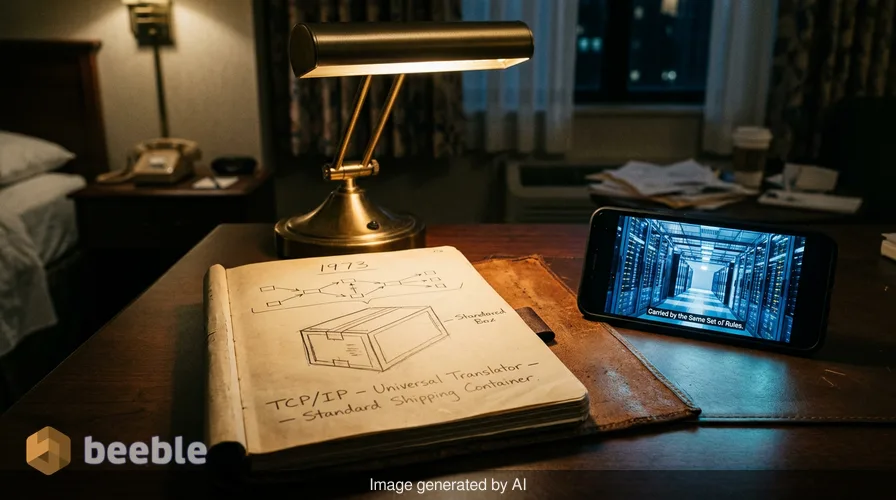
In 1973, a computer scientist named Vinton Cerf sat in a hotel room in Palo Alto and worked on a problem that few people even knew existed. At the time, computers were massive, expensive machines that mostly lived in government labs and universities. These machines could talk to other machines in their own small networks, but they were effectively deaf to any network that used a different set of rules. Cerf and his colleague Robert Kahn decided to build a universal translator. They designed a set of protocols known as TCP/IP. This was the digital equivalent of a standard shipping container. It did not matter what was inside the box or what ship was carrying it. As long as the box met the standard, it could travel anywhere in the world.
Today, that same set of rules carries every email, video stream, and bank transaction on the planet. Next week, Cerf will step down from his role at Google. At 83, he is concluding a career that spanned the entire history of the modern internet. While he spent the last two decades as Google’s chief internet evangelist, his real legacy is the invisible architecture that allows the device in your pocket to talk to a server on the other side of the world.
A graduation from the school of connection
The announcement of Cerf’s retirement came during a conference at the University of California, Berkeley. Dave Patterson, a fellow pioneer in computer architecture, shared the news with a room full of researchers and students. Patterson recalled meeting Cerf in the 1970s. While most computer scientists of that era wore shaggy hair and casual clothes, Cerf always wore a three-piece suit. He told the audience he wanted to stand out by being the best-dressed person in the room. This preference for formality extends to his work. He is a man who believes in precise rules and clear communication between systems.
Cerf joined Google in 2005. At that time, the company was still young and the mobile internet was in its infancy. His job was to look at the big picture of where the internet was going. He traveled the world to talk to governments about infrastructure and worked on projects to bring connectivity to the most remote parts of the globe. He even spent time designing protocols for an Interplanetary Internet, aiming to ensure that when humans eventually land on Mars, they have a way to send data back to Earth without it getting lost in the vastness of space.
How a simple set of rules conquered the world
To understand why Cerf is so respected, you have to look under the hood of how data moves. Before TCP/IP, networking was a mess of proprietary systems. If you bought a computer from one company, it could only talk to other computers from that same company. This created silos that limited the utility of technology. Cerf and Kahn changed this by focusing on decentralization. They did not want a single master computer in charge of everything. Instead, they wanted a system where every piece of the network was responsible for its own small part of the journey.
In everyday life, you can think of TCP/IP like the global postal system. When you send a letter, you do not care if it travels by truck, plane, or boat. You only care that the address is written in a format the post office understands. TCP (Transmission Control Protocol) handles the packaging. It breaks your data into small pieces, numbers them, and checks to make sure they all arrive at the destination. IP (Internet Protocol) is the address on the envelope. It makes sure the pieces get to the right house. This simplicity is exactly why the internet grew so fast. Anyone could join the network as long as they followed these two basic rules.
Why your AI assistant needs a better dictionary
Cerf is not just looking at the past. During his final public appearances, he has been vocal about the next major shift in technology: the rise of AI agents. These are pieces of software that do not just answer questions but take actions on your behalf. An AI agent might book your travel, manage your calendar, or coordinate a complex project with other AI agents.
Currently, many people interact with AI using natural language. You type a prompt in English, and the AI responds in English. Many tech leaders believe that AI agents will simply talk to each other in English too. Cerf disagrees. He argues that natural language is too messy and ambiguous for software to use reliably. He uses the analogy of the old telephone game. If one AI whispers a request to another AI in English, and that AI passes it to a third, the original meaning will eventually change.
For the average user, this is a practical problem. If your personal AI assistant tells a flight-booking AI to find a seat, they both need to be 100% sure about the terms of the deal. A misunderstanding could result in a non-refundable ticket for the wrong date. Cerf believes we need a new set of formal, mathematical standards for AI interaction. This would be a new TCP/IP for the age of artificial intelligence. It would ensure that different AI models from different companies can work together without errors.
The return of the protocol wars
Historically, tech companies prefer to build walled gardens. They want you to stay inside their ecosystem so they can collect your data and your subscription fees. We see this today with messaging apps. You cannot easily send an iMessage to a WhatsApp user or a Slack message to a Discord user. These systems are opaque and disconnected.
Cerf warns that we are heading toward a similar problem with AI. If Google’s AI cannot talk to Apple’s AI because they lack a common language, the user is the one who loses. The agentic model of AI requires what Cerf calls composability. This means different tools from different sources must fit together like Lego bricks.
On the market side, the companies that set these standards will have massive influence. If a specific way of "AI talking" becomes the global standard, the company that invented it becomes the gatekeeper. This is a repeat of the early internet protocol wars of the late 1980s. Back then, various government and corporate entities tried to push their own rules for the web. TCP/IP won because it was open and free for everyone to use. Cerf’s retirement marks the end of an era where openness was the default goal.
A practical legacy for the digital citizen
Looking at the big picture, Cerf’s departure is a moment to appreciate the invisible backbone of modern life. We often take the internet for granted, treating it like a utility as common as water or electricity. However, the internet was a choice. It was a choice to build a system that was decentralized, open, and owned by no one.
For the consumer, Cerf’s career offers a lesson in the value of standards. When you buy a new gadget today, it usually works because of the work he did decades ago. As we move into a world filled with autonomous software and complex AI, we should look for that same spirit of interoperability. If a new technology does not let you move your data or talk to other systems, it is a step backward from the vision Cerf spent fifty years building.
Cerf’s retirement is a reminder that the best technology is often the kind you never have to think about. It is the quiet, reliable protocol that lets you send a photo to your family or buy a movie ticket without wondering if the networks are compatible. As he hangs up his three-piece suit, the challenge for the next generation of engineers is to make AI as simple and universal as the internet he gave us. The bottom line is that the digital world functions best when it is built on shared rules rather than private walls.
Sources
- Association for Computing Machinery (ACM) - Turing Award Archives
- Google Corporate Leadership and Chief Internet Evangelist Biography
- Laude Institute - Open Frontier Conference Proceedings
- The Internet Society - History of TCP/IP and the Internet Protocol Suite
- National Institute of Standards and Technology (NIST) - Agentic AI Technical Reports



See you on the other side.
Our end-to-end encrypted email and cloud storage solution provides the most powerful means of secure data exchange, ensuring the safety and privacy of your data.
/ Create a free account
