


Why New York City's new driver law has Uber and Lyft heading to court

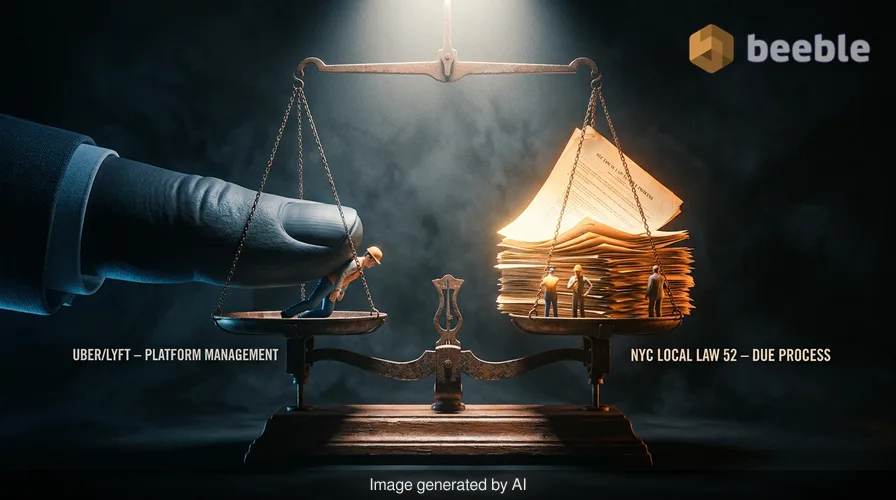
A ride-share driver in Queens receives a notification on their phone. It is a digital pink slip. Within seconds, their ability to earn a living vanishes because of a passenger complaint or a low rating. For years, this was the reality of the gig economy. The apps had the power to deactivate anyone at any time. New York City recently decided to change that reality with a regulation called Local Law 52. This law turns the quick tap of a deactivation button into a formal legal process. Uber and Lyft are now suing the city in Manhattan federal court to stop this law from taking effect on July 28.
This legal fight is about the balance between a worker’s right to keep their job and a company’s right to manage its platform. In the eyes of the law, this is a clash over the definition of fairness. Uber and Lyft argue that the city is overstepping its authority and forcing them to keep dangerous people on the road. The City Council argues that drivers deserve basic protections against arbitrary firing. This conflict is more than a corporate dispute. It changes how safe you are in a car and how stable a driver’s life is in one of the most expensive cities in the world.
The digital pink slip becomes a legal battle
Uber and Lyft filed separate lawsuits within 24 hours of each other. They are challenging a law that the City Council passed in January, overrunning a veto by former Mayor Eric Adams. The companies argue that the law is a violation of their constitutional rights, specifically their right to free speech and due process. Due process is the legal requirement that the government must respect all legal rights that are owed to a person. In this context, the companies believe the city is taking away their right to run their business as they see fit.
At the heart of the lawsuit is the claim that Local Law 52 is hazardous and reckless. The companies state that if they cannot quickly remove a driver accused of misconduct, the public is at risk. This is a serious claim because both companies already face thousands of lawsuits across the country related to driver misconduct. By June 2026, Uber faced over 3,500 lawsuits while Lyft faced dozens. These cases often involve allegations of sexual assault or fraud. The companies argue that the city's new rules make it harder to prevent these incidents.
What exactly is local law 52?
Local Law 52 changes the rules of engagement for ride-share apps. Under this regulation, large companies cannot dismiss a driver unless they have a bona fide economic reason or just cause. Just cause is a legal term that means a business has a legitimate, provable reason to fire someone. It is common in union contracts but rare in the gig economy.
Under the new law, a company must provide 14 days' notice before they let a driver go. This is a massive shift from the current system, where deactivation happens instantly. The companies also face a new requirement to potentially rehire drivers they deactivated as far back as 2019 if those drivers did not receive proper notice. This look-back provision is a major point of contention in the lawsuits because it could force the apps to reactivate thousands of accounts that they previously closed for various reasons.
The heavy backpack of proof
In a typical courtroom, the person who brings a lawsuit usually has the responsibility to prove their case. This is the burden of proof. It is helpful to think of the burden of proof as a heavy backpack that one side must carry up a hill. Local Law 52 puts this heavy backpack squarely on the shoulders of Uber and Lyft.
If a driver challenges their deactivation in court or arbitration, the company must prove that the deactivation was fair. Arbitration is a way to resolve disputes outside of a courtroom with a neutral third party. The apps argue that this heightened requirement makes it nearly impossible to win a case. They claim that if a passenger makes a complaint but does not want to testify, the company will lose the case and be forced to keep the driver. This creates a situation where the company is liable for a driver's actions but lacks the power to remove them.
Privacy concerns for the everyday passenger
One of the most controversial parts of the law involves passenger privacy. The law requires that if a driver is accused of misconduct, the company must provide the driver with the details of that misconduct. Uber and Lyft argue that this forces them to reveal sensitive information about passengers to the very people accused of harassing or harming them.
This creates a chilling effect on reporting. A passenger might be willing to tell an app that a driver made them feel unsafe, but they may not want that driver to see their specific testimony. The companies argue that this part of the law protects the driver at the expense of the victim. They believe this violates their reputation and the trust they have built with their customers.
Comparing the old system to the new law
| Feature | Current Practice | Local Law 52 Requirement |
|---|---|---|
| Deactivation Speed | Instant and automated | 14 days' notice required |
| Reason for Firing | At-will (any reason) | Just cause or economic reason |
| Burden of Proof | Driver must prove unfairness | Company must prove just cause |
| Retroactive Claims | Generally not allowed | Drivers since 2019 can seek re-entry |
| Evidence | Anonymous passenger reports | Detailed reports shared with driver |
Why the companies claim the law is hazardous
Lyft and Uber characterize the law as an attack on public safety. They argue that the 14-day notice period is a window of danger. If a driver is accused of something serious, the companies want them off the road immediately. They claim that being forced to wait two weeks allows a potentially dangerous individual to continue picking up passengers.
City Council members see the situation differently. They argue that many deactivations are the result of software glitches or unfair customer complaints. They believe drivers are vulnerable workers who need a shield against corporate overreach. The law is a shield intended to prevent a driver from losing their entire livelihood because of a single biased review or a technical error in an algorithm.
What this means for New York City residents
If you live in or visit New York City, this legal battle affects you directly. If the law is upheld, you might find that the process of reporting a bad driver becomes more complex. You might be asked to provide more detail or participate in a dispute process. On the other hand, if you are one of the thousands of drivers in the city, this law provides a level of job security that did not exist before.
The case is currently in the hands of the New York City law department. They are reviewing the lawsuits filed by Uber and Lyft. The outcome will likely set a precedent for other cities across the United States. Precedent is a legal decision that serves as a guide for future similar cases. If New York City wins, expect other cities like Chicago or Los Angeles to follow suit with similar driver protection laws.
Practical steps for drivers and passengers
While the court decides the fate of Local Law 52, there are steps you can take to protect your rights.
For drivers:
- Keep detailed records of your trips and any interactions with passengers.
- Save copies of all communications from the app regarding your performance or ratings.
- If you receive a deactivation notice, respond in writing immediately and ask for the specific reason.
- Join a driver advocacy group to stay updated on the legal status of the law.
For passengers:
- Continue to report any safety concerns through the app immediately.
- Be as specific as possible in your reports, noting the time, location, and nature of the incident.
- Understand that your report is a legal document that may be used if the driver challenges their deactivation.
- If an incident is serious, contact local law enforcement in addition to the ride-share company.
Sources
- New York City Local Law 52 of 2026.
- U.S. Constitution, Fourteenth Amendment (Due Process Clause).
- Manhattan Federal Court filings: Uber Technologies v. City of New York and Lyft v. City of New York.
- Statements from New York City Council Speaker Julie Menin and Council Member Shekar Krishnan.
This article is for informational and educational purposes only. It does not constitute formal legal advice. The law is constantly changing and varies by jurisdiction. If you are facing a legal issue related to employment, deactivation, or consumer safety, you should consult a qualified attorney in your area to discuss the specific facts of your case.



See you on the other side.
Our end-to-end encrypted email and cloud storage solution provides the most powerful means of secure data exchange, ensuring the safety and privacy of your data.
/ Create a free account
