


Europe is sitting on 3 trillion euros of idle potential it refuses to spend

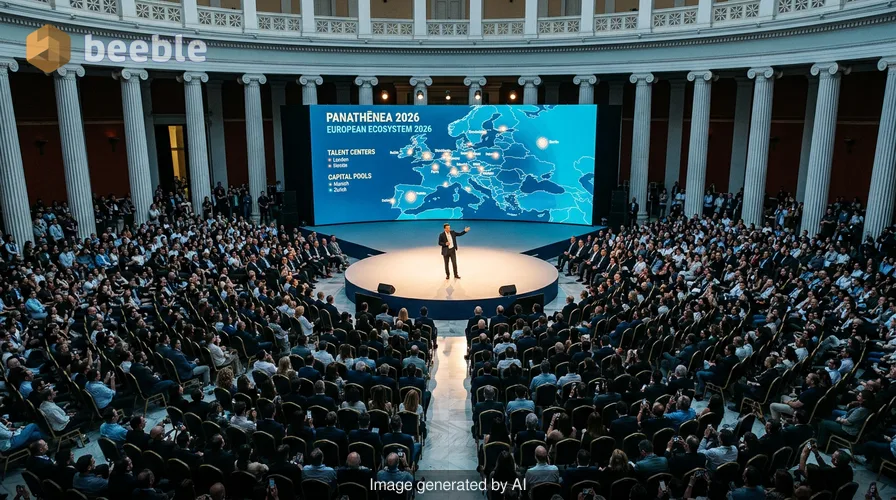
In the late 19th century, Europe was the undisputed workshop of the world. Factories in Manchester, Berlin, and Paris churned out the machinery that defined the modern era. Wealthy families and institutional banks funded the railways and telegraph lines that connected continents. Today, that historical dominance feels like a distant memory. While the United States and China trade blows over semiconductor supremacy and artificial intelligence breakthroughs, Europe often finds itself in the role of an interested spectator. The recent Panathēnea 2026 event in Athens made one reality clear. The continent has the components for success but lacks the hardware to assemble them.
More than 11,500 people gathered at the Zappeion in Athens to discuss a singular problem. Europe has plenty of talent and a mountain of cash, yet it fails to build global tech champions at the same rate as its rivals. This isn't a lack of intelligence or creativity. It is a fundamental disagreement with the concept of risk. To understand why your next favorite app or the software running your workplace probably won't be European, we have to look at how money moves across the continent.
The massive price of playing it safe
Markus Villig, the founder of Bolt, arrived in Athens with a sobering statistic. He estimated that the European economy loses between 2 and 3 trillion euros every year because of its conservative approach to money. For the average person, this sounds like an abstract number. In reality, it is the cost of hesitation. Europe is one of the wealthiest regions on the planet, but that wealth is often stagnant. It sits in low-yield bank deposits or traditional savings accounts rather than flowing into the businesses that define the next decade.
In the United States, retail investment is a common part of daily life. Everyday people put their savings into the stock market, which in turn provides the capital companies need to grow. In Europe, the culture is different. There is a systemic preference for safety over growth. Villig noted that his company, Bolt, started in Estonia. As a small Eastern European nation, Estonia lacked the massive capital pools found in London or New York. This forced the company to find highly dedicated people who were willing to build something global out of necessity.
Looking at the big picture, this idle capital is like a fleet of ships parked in a harbor during a trade boom. The ships are there, the crews are ready, but the owners are too afraid of a storm to leave the dock. This caution has a tangible impact on the job market. When local capital stays in the bank, local startups cannot scale. They either die or move to Silicon Valley to find the funding they need to survive.
Why startups must be global from day one
Historically, a business would start in a local town, expand to the region, and eventually consider going abroad. That model is dead. Suo Wang, the co-founder of the payroll giant Deel, explained that modern companies have to be international from their first hour of existence. Deel handles payments for 40,000 businesses across 160 countries. It does not think in terms of borders because the internet does not have them.
For the average user, this shift is why you can use the same ride-hailing app in Lisbon that you use in Tallinn. Technology has streamlined the way we interact with services, making geography almost irrelevant. Wang moved from China to the US at 16 and built a company that solves a real, global problem: paying people regardless of where they live. She argued that success is not about having the flashiest tech. It is about whether a company solves a problem that exists everywhere.
European founders often make the mistake of focusing too much on their home market. They spend years perfecting a product for Germany or France, only to find that an American competitor has already captured the rest of the world. The decentralized nature of Europe, with its different languages and regulations, is a challenge. However, as Wang pointed out, new technologies now allow startups to ignore these barriers from the start. A company founded in a basement in Athens has the same digital reach as one in a glass tower in San Francisco.
The Greek example of failing upward
George Daskalakis, the co-founder of Kaizen Gaming, shared a perspective that is rare in European business circles. He spoke openly about failure. In many European cultures, a failed business is a permanent stain on a professional reputation. In the US, it is often viewed as a necessary tuition fee for future success. Daskalakis recalled how his company’s first attempt to expand into Poland was a disaster.
Instead of retreating to the safety of the Greek market, the company analyzed its mistakes and tried again in Romania. That second attempt worked. Today, Kaizen Gaming is a major player in 20 markets across three continents. Daskalakis noted that the phrase "If you can make it here, you can make it anywhere" usually refers to New York. He argued the same applies to Greece. The difficulty of building a business in a smaller, more regulated market creates a resilience that is useful on the global stage.
Essentially, the path to a global tech champion is not a straight line. It is a series of corrections. If European investors and governments continue to punish failure, they will continue to stifle innovation. Innovation is messy and unpredictable. It requires an environment where a founder can lose everything on their first try and still find the support to start a second venture.
A comparison of the global innovation race
To put the current gap into perspective, we can look at how different regions prioritize their growth. The following data highlights the disparity in how these economies function.
| Metric | United States | China | Europe |
|---|---|---|---|
| Primary Funding Source | Private Venture Capital | State-Led & Private Mix | Bank Loans & Grants |
| Risk Appetite | High (Fail Fast) | High (Rapid Scale) | Low (Preserve Capital) |
| Market Focus | Global from Day One | Large Domestic First | Local/Regional First |
| Idle Capital | Low (High Market Participation) | Moderate | High (Trillions in Deposits) |
| Regulation Style | Market-Driven | State-Directed | Compliance-First |
This table shows that Europe's struggle is not a lack of resources. It is a structural issue. The preference for bank loans and government grants over venture capital creates a slower, more cautious growth cycle. While a bank wants to see collateral and guaranteed returns, a venture capitalist is looking for the next disruptive idea that could change an industry.
What this means for you
From a consumer standpoint, Europe’s innovation gap has everyday consequences. When the most successful tech companies are based elsewhere, your data, your digital tools, and your job opportunities are determined by foreign interests. Under the hood, the algorithms that decide what you see on social media or how much you pay for a flight are rarely designed with European values or economic interests in mind.
Practically speaking, the bottom line is about your career and your wallet. If Europe successfully closes the investment gap, it means more high-paying tech jobs at home. It means local startups can grow into giants without selling out to American or Chinese firms. It also means more competition, which usually leads to better services and lower prices for the end user.
Ultimately, the shift required is cultural. It is about moving money from under the mattress and putting it into the hands of people who are willing to build something new. The Panathēnea 2026 event served as a reminder that the talent is already here. The capital is already here. The only thing missing is the courage to use them.
European consumers should watch how their local governments handle pension funds and investment regulations. A shift toward more active participation in the tech economy could be the difference between a continent that leads the next industrial age and one that simply buys its products from abroad. The choice to remain safe is the riskiest move of all.



See you on the other side.
Our end-to-end encrypted email and cloud storage solution provides the most powerful means of secure data exchange, ensuring the safety and privacy of your data.
/ Create a free account
