


How a 5,000-book order in Galway reveals the hidden violence of artificial intelligence

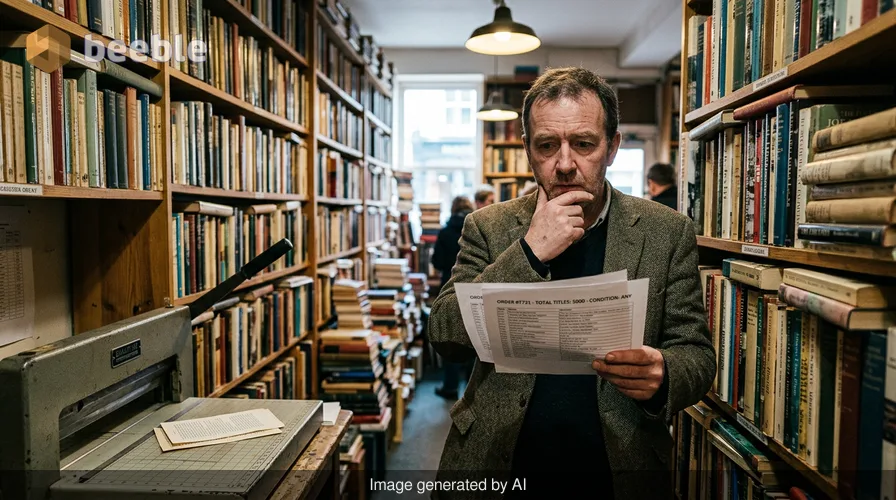
Tomás Kenny stands in the quiet aisles of his family bookstore in Galway, looking at a spreadsheet that feels like a glitch in the social fabric of his trade. The order is for 5,000 obscure titles. There is no request for a discount, no inquiry about the condition of specific first editions, and no interest in the history of the collection. In the world of rare books, where every transaction is a conversation and every price is a negotiation, this silence is an anomaly. The buyer is anonymous, efficient, and well-funded. For a bookseller who views his inventory as a collection of cultural anchors, this transaction feels less like commerce and more like a harvest.
Zooming out from this small shop in Ireland, a pervasive anxiety is spreading through the global community of antiquarian booksellers. The suspicion is that these bulk orders are not destined for private libraries or university archives. Instead, these books are likely headed for high-speed scanning facilities where their spines will be sheared off by industrial guillotines. Once the pages are loose, they are fed into automated scanners to train the next generation of large language models. The physical book, a visceral artifact of human history, is reduced to a disposable container for data. This is the logic of the modern tech race: the fastest way to digitize the world is to destroy the medium that preserved it.
The mechanical violence of project panama
This fear is not unfounded. The discovery of Project Panama, a codename used by the AI firm Anthropic, revealed a systematic approach to destructive scanning. According to legal filings from 2025, the company reportedly purchased millions of print books to accelerate the training of its models. The process is a study in industrial efficiency. Workers or machines remove the bindings to allow for rapid, flat-bed scanning. This method eliminates the distortion caused by the curve of a book’s gutter, ensuring the AI receives the cleanest possible text. Once the data is ingested, the original pages often end up in the pulp mill. The physical object is treated as a temporary obstacle to the acquisition of information.
Paradoxically, the very qualities that make a book rare—its age, its unique marginalia, its specific paper quality—are exactly what make it attractive to AI developers. These companies have exhausted the supply of high-quality digital text available on the open web. To improve the reasoning and nuance of their models, they require the deep, structured thought found in long-form print. A 19th-century treatise on sociology or a rare collection of 17th-century poetry offers a linguistic density that a Reddit thread or a blog post cannot provide. Through this lens, the history of human thought becomes a raw material, stripped of its physical context to fuel a digital machine.
Liquid modernity and the atomized library
Sociologically, this trend is a textbook example of what Zygmunt Bauman called liquid modernity. In this state, social structures and cultural objects lose their fixed form and become fluid, transient, and ephemeral. A book was once a permanent fixture, a heavy object that demanded a specific place on a shelf and a specific kind of attention. In the hands of an AI firm, the book is liquefied. It is broken down into tokens and parameters, stripped of its weight and its history. The library is no longer a place of collective memory; it is an atomized data set.
| Scanning method | Preservation status | Speed and cost | Primary use case |
|---|---|---|---|
| Destructive (Spine-cutting) | Total loss of physical artifact | High speed, lowest cost | Mass AI training and data scraping |
| V-shape robotic scanning | Book remains intact, potential for page stress | Medium speed, high equipment cost | Large-scale library digitization |
| Manual (Internet Archive style) | Full preservation of artifact and context | Slowest speed, labor-intensive | Rare books, archives, and special collections |
This shift transforms our relationship with the past. When we view language as an archaeological site, we recognize that every book is a layer of cultural change. The physical notes in the margins, the texture of the paper, and even the smell of the ink are data points that tell us how people once made sense of their world. When an AI firm pulps a rare book after scanning it, they are effectively bulldozing the site after taking a few photographs. The information survives in a fragmented, digital form, but the systemic connection to the past is severed.
The human rhythm of the internet archive
In contrast to the sterile efficiency of Project Panama, the Internet Archive operates with a different habitus. This is the sociological term for the deeply ingrained habits and skills we possess through experience. For Eliza Zhang, a scanner who has spent over a decade with the Archive, the work is a meditative practice. She turns pages with clean, dry hands. She uses a foot pedal to raise the glass, adjusting the cameras for every unique fold-out and illustration. This is scanning the hard way, a process that views the book not as a problem to be solved, but as a guest to be hosted.
On an individual level, the work of manual scanning preserves the soul of the text. Zhang often pauses to read the titles she handles, finding meaning in the mundane and the extraordinary alike. This human intervention ensures that errors—like a disembodied hand obscuring a line of text or a skipped page—are caught in real-time. The Internet Archive’s commitment to non-destructive scanning is a form of cultural resilience. It stands as a refusal to accept the idea that speed is the only metric of progress. By keeping the book intact, they ensure that future generations can still experience the visceral reality of a primary source.
The algorithm as an archaeological looter
Historically, the destruction of books was a tool of censorship or war. Today, it is a byproduct of the attention economy. AI firms are in a race to achieve a level of intelligence that requires more data than the internet can provide. This has turned rare books into a commodity for a market that does not value them as books. When a company like ISBNdb advertises bulk sourcing for AI clients, they are participating in a structural shift where the value of a book is decoupled from its readership. A book is now worth what its data can contribute to a model's weights.
This leads to a chilling effect on the industry. Booksellers like Tomás Kenny are now forced to act as moral gatekeepers. They must decide if a sale is worth the potential destruction of the work. If a buyer refuses to haggle, it is a signal that the buyer is not an enthusiast but a corporate agent. This changes the social contract of the bookstore. It is no longer just a place for the exchange of ideas; it is a defensive fortification against the erosion of physical culture.
Reclaiming the physical anchor
Ultimately, the fight over rare books and AI is a fight for the future of our collective memory. If we allow the physical records of our history to be pulped for the sake of digital efficiency, we risk living in a world of mirrors where everything we read is a synthetic reflection of a lost original. Digital communication is often like a fast-food diet—quick and accessible, but lacking deep emotional nutrition. The physical book remains a necessary anchor in a sea of systemic chaos.
Culturally speaking, we must ask what we gain when we trade a rare volume for a faster chatbot. The data may be the same, but the experience of the human connection to the past is not. We should consider the labor of people like Eliza Zhang, who prove that preservation is a choice we make every day. As you look at your own bookshelf, realize that those volumes are more than just paper and ink. They are evidence of a world that existed before the algorithm, and they are a reminder that some things are too precious to be fed into the wood chipper.
Take a moment to visit a local bookstore or a library. Hold an old book in your hands and notice the weight of it. Consider the history of that specific object and the hands it has passed through. In an era of liquid modernity, the act of preserving a physical book is a quiet, profound form of rebellion. We do not have to accept the destruction of the past as the price of the future. The hard way is often the only way to save what truly matters.
Sources
- Bauman, Zygmunt. Liquid Modernity. Cambridge: Polity Press, 2000.
- The Atlantic. "The AI Firms Turning Rare Books Into Data."
- The Irish Times. "Kennys Bookshop and the 5,000-Book Mystery."
- Internet Archive Blog. "Scanning the Hard Way: A Day in the Life of Eliza Zhang."
- 404 Media. "Inside Project Panama: The Destructive Scanning of Anthropic."



See you on the other side.
Our end-to-end encrypted email and cloud storage solution provides the most powerful means of secure data exchange, ensuring the safety and privacy of your data.
/ Create a free account
