


Inside the legal battle to make tech giants pay for the news you read

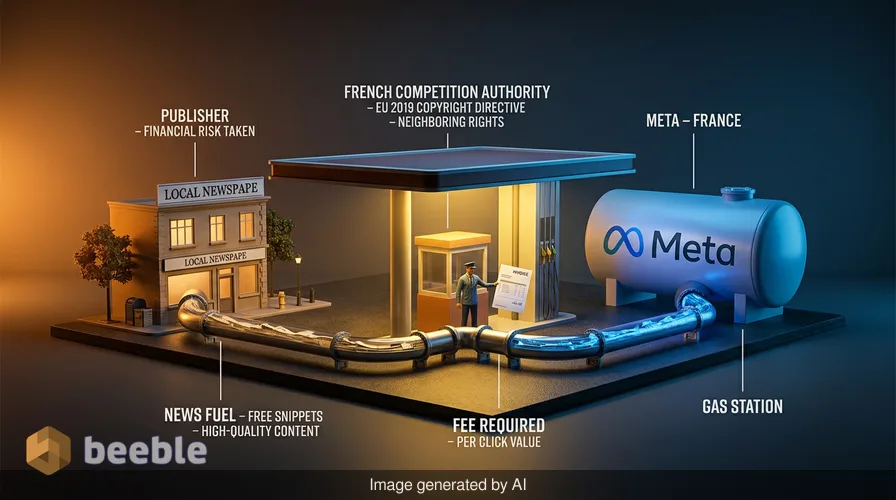
Here is a reality that tech companies prefer to keep quiet. Every time you scroll through a news feed on your phone, a complex financial tug-of-war happens in the background. You see a headline and a photo for free. The publisher sees a potential reader who never visits their website. The platform sees an opportunity to keep you on their app to show you ads. France just opened a door to this room of secrets by ordering Meta to resume payments to news organizations. The country's competition authority is not just asking for a conversation. It is demanding a transparent accounting of how much your clicks are worth.
Why neighboring rights are the focus of the fight
To understand this dispute, you must understand a legal concept called neighboring rights. In the eyes of the law, these rights are similar to copyright but they protect a different group of people. If copyright protects the author of a book, neighboring rights protect the publisher who took the risk to print, market, and distribute that book. Under the European Union 2019 Copyright Directive, news publishers have a statutory right to ask for a fee when platforms like Facebook or Google display snippets of their work. This law is a shield for local newspapers that are vulnerable to the massive reach of US tech firms.
Think of the news as the fuel for the social media engine. Without current events to discuss, these platforms would be far less interesting to users. In practice, the law treats this like a toll road. If Meta wants to use the high-quality path cleared by professional journalists, it must pay the toll. France was the first country to turn this EU directive into a binding domestic law. Consequently, the world is watching how French regulators handle these negotiations.
The expiration of the 2021 agreements
For a brief period, there was peace. In 2021 and 2022, Meta signed deals with French press groups like the Alliance de la Presse d’Information Générale (APIG) and the Société des Droits Voisins de la Presse (DVP). These contracts acted as a bridge between the tech giant and hundreds of publications. They ensured that French publishers received money for the content that appeared on Facebook. However, those agreements reached their end dates in December 2024 and January 2025. When the clock ran out, the payments stopped.
Meta did not remove the news content once the deals expired. Instead, news stories continued to appear in user feeds. Curiously, Meta took the position that it no longer had a legal obligation to pay for this content. The publishers argued that Meta was essentially taking their property without a valid license. This situation created an immediate financial gap for newsrooms. The Autorité de la concurrence, France’s competition regulator, stepped in because this standoff threatened the survival of many smaller news outlets.
The abuse of a dominant position
In a regulatory context, the authority believes Meta has too much power. This is what lawyers call an abuse of a dominant position. When one company controls such a large share of the market, it can dictate terms to everyone else. The regulator noted that Meta’s refusal to negotiate in good faith caused serious and immediate harm to the press sector. Press content is precarious enough without a tech giant cutting off a major source of revenue.
The authority also pointed out that Meta was not being transparent. To calculate a fair price for news, publishers need to know how much money Meta makes from those news posts. Meta has 15 days to provide this information. This transparency is fundamental to the negotiation process. Without data, a contract is just a guess. The regulator is forcing Meta to show its cards so that publishers can negotiate from a position of relative strength.
Including Instagram and Threads in the deal
One of the biggest sticking points in this case involves the scope of the talks. Meta wanted to limit the negotiations to Facebook. It argued that Instagram and Threads are different types of services that do not rely on news in the same way. The French authority rejected this argument. It stated that these services also distribute news and should be part of the overarching agreement. Excluding them would create a legal loophole that Meta could use to avoid payments.
This decision is a warning to tech companies that they cannot simply move content to a different app to escape their bills. In the eyes of the law, if the content is there and the platform benefits from it, the platform must pay. This comprehensive approach ensures that the law keeps pace with how people actually consume news. Many younger readers get their headlines from Instagram rather than Facebook. If the law ignored those platforms, the protection for publishers would be null and void for an entire generation of readers.
Following the path of the Google fine
This is not the first time France has challenged a tech giant. In 2024, the authority fined Google 250 million euros for similar issues. Google failed to follow through on its promises to negotiate fairly and used news content to train its artificial intelligence tools without telling the publishers. That case set a strong precedent for the Meta order. It proved that the French government is willing to use litigation and heavy fines to enforce its rules.
Meta now faces a choice. It can return to the table and find a fair price for news, or it can risk the same kind of massive penalties that Google faced. The regulator is currently using interim measures. These are temporary orders meant to stop the harm while the full case is decided. Ultimately, this means Meta must act now. It cannot wait for a final court ruling that might take years to arrive.
What this means for your digital life
If you are a regular user of these apps, you might wonder if this fight will change your experience. In the short term, you likely will not see a difference. Your feed will still have headlines and stories. However, the long-term impact is significant. A healthy democracy relies on a robust press that can afford to investigate the truth. If platforms take all the profit from news, the people who write the news eventually go out of business.
These negotiations are about finding a sustainable way for tech and journalism to coexist. It is a multifaceted problem that requires a nuanced solution. As a result of this order, the conversation is moving forward. For the average citizen, this is a win for transparency and fairness in the digital age.
How to support local journalism
While the regulators and tech giants fight in court, there are steps you can take to ensure your favorite news sources survive. This legal battle shows how much power these platforms have over the information you see.
- Visit news websites directly rather than relying on social media feeds.
- Subscribe to local newspapers to provide them with a predictable income.
- Use dedicated news aggregator apps that have formal agreements with publishers.
- Report any bugs or issues with news links to the publishers so they can maintain their traffic.
Sources
- EU Copyright Directive 2019/790, Article 15
- French Intellectual Property Code, Article L132-35
- Autorité de la concurrence, Decision 24-MC-04 regarding interim measures against Meta
- French Competition Act, Article L420-2
Disclaimer: This article is for informational and educational purposes only and does not constitute formal legal advice. Laws regarding digital copyright and competition vary by jurisdiction. You should consult a qualified attorney in your area for specific legal issues related to content rights or business negotiations.



See you on the other side.
Our end-to-end encrypted email and cloud storage solution provides the most powerful means of secure data exchange, ensuring the safety and privacy of your data.
/ Create a free account
