


Why OpenAI’s New Digital Watermark Won’t Stop You From Being Tricked

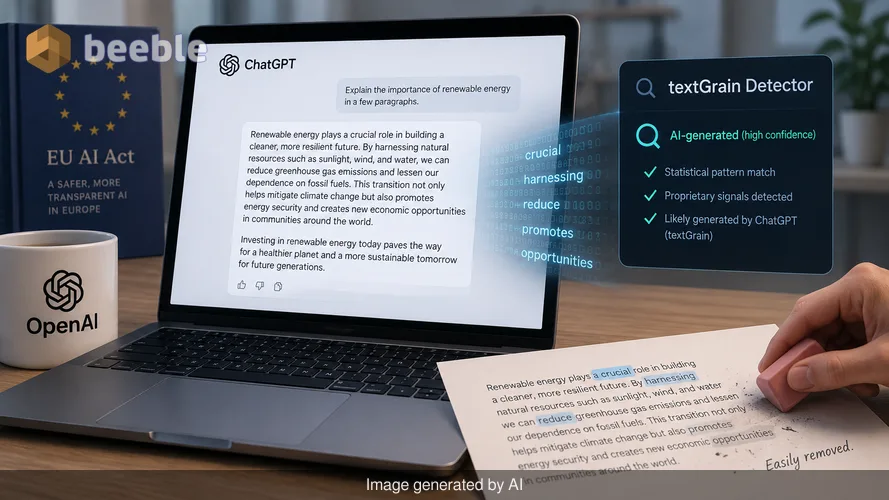
While the world demands clarity on what is human and what is machine, OpenAI just launched a tool that promises transparency but delivers something far more fragile. The company recently announced that ChatGPT will now watermark its text outputs by default for users in the European Union. This change follows the requirements of the EU AI Act, which mandates that AI-generated content must be detectable. However, the reality under the hood suggests this new digital seal is less like a permanent brand and more like a light pencil mark that a child could erase with a single swipe.
OpenAI calls its new method textGrain. In simple terms, this is a proprietary system that embeds statistical patterns into the words the AI chooses. For the average user, the text looks identical to any other response. The grammar is fine, the tone is consistent, and the information is the same. But to a specialized detector tool, those word choices act as a fingerprint. This system operates like a tireless intern who has been told to use a specific set of synonyms whenever they write a memo. If you know the pattern, you can identify the intern. If you do not know the pattern, the memo looks perfectly standard.
The fragility of invisible patterns
Looking at the big picture, the effectiveness of textGrain depends entirely on the text remaining untouched. OpenAI’s own data reveals a startling vulnerability that most corporate press releases would prefer to gloss over. In ideal conditions, the tool has a 92 percent success rate in identifying its own writing. This sounds impressive until you apply the smallest amount of human effort.
Changing just 10 percent of the generated text causes the detection rate to plummet by almost 30 percent. If a user swaps out 20 percent of the words—perhaps by changing a few adjectives or rephrasing a couple of sentences—the success rate drops by nearly 75 percent. Practically speaking, anyone with a basic grasp of a thesaurus can bypass this system in seconds. This makes the watermark a compliance tool for regulators rather than a reliable safety net for the public. It satisfies the letter of the law in the EU without actually solving the overarching problem of AI deception.
A tale of two corporate strategies
On the market side, the contrast between OpenAI and its primary competitor, Anthropic, is stark. Anthropic introduced its own watermarking system earlier this year but chose to enable it for all users globally. OpenAI has taken a more selective path, turning the feature on by default only where the law demands it. Users in the United States, Asia, and other regions will still have "clean" outputs unless they or their organizations manually opt in through an API.
This regional divide creates a fragmented digital environment. A student in Berlin will receive watermarked essays by default, while a student in New York will not. From a consumer standpoint, this suggests that OpenAI views watermarking as a regulatory hurdle to clear rather than a foundational feature of a trustworthy product. The company is doing the bare minimum to remain legal in the EU while keeping its product as frictionless as possible elsewhere.
| Feature | OpenAI textGrain | Anthropic Watermarking |
|---|---|---|
| Default Region | EU Only | Global |
| Detection Rate | 92% (Ideal) | High (Proprietary) |
| Editing Sensitivity | High (20% change breaks it) | Moderate to High |
| Access | Limited Researchers | Public/API |
| Standard | Proprietary | Proprietary/C2PA |
The technical hurdle of text vs images
Under the hood, watermarking text is significantly harder than watermarking images or video. When a system like DALL-E or Midjourney creates an image, it can hide metadata in the pixels or adjust the noise patterns in a way that remains invisible to the eye but obvious to a computer. These pixels are dense and offer thousands of places to hide a signal.
Text is different because it is sparse. A sentence only has so many words, and each word has a limited number of synonyms that make sense in context. If the AI forces a specific word choice to maintain the watermark, it risks making the writing sound clunky or repetitive. OpenAI claims textGrain does not lower quality, but the statistical trade-off is always present. To keep the watermark detectable, the AI must sacrifice a small amount of its creative randomness. This is why the detection rate is even lower for short messages or translated text. There simply is not enough data in a three-sentence email to hide a complex mathematical fingerprint.
What this means for your digital life
For the everyday user, the arrival of textGrain should be met with healthy skepticism. If you are a teacher, an editor, or a hiring manager, you cannot rely on these detectors to provide a definitive answer. The system is too easy to game. A user can take a ChatGPT output, run it through a different, non-watermarked AI for a quick rewrite, and the original watermark will vanish.
Ultimately, this is a systemic shift in how we view digital proof. We are moving away from a world where we can trust what we see and toward a world where we need a "key" to verify authenticity. OpenAI is currently keeping that key behind a velvet rope, granting access only to a limited number of researchers and organizations. This opacity creates a new kind of power imbalance. The company that creates the content is also the only one that can reliably catch it, and even then, they can only catch it if the user is lazy.
Navigating a watermarked world
Practically speaking, the rollout of textGrain in the EU is a beta test for a future where all digital labor is tagged. It serves as a reminder that the tools we use are increasingly subject to the invisible backbone of international law. While the EU AI Act aims to protect citizens from being misled by deepfakes and automated propaganda, the technical tools available are not yet resilient enough to meet that goal.
Consumers should observe their own habits as these features roll out. You might notice subtle shifts in how ChatGPT phrases its answers as the model tries to maintain its statistical fingerprint. You might also see a rise in "AI-cleaner" tools—simple programs designed specifically to rewrite text just enough to strip away these markers. The cat-and-mouse game between AI labs and users is entering a new, more localized phase.
As we move forward, stop looking for a badge or a stamp that says "Made by AI." These markers are becoming part of the digital crude oil that powers our apps, hidden deep within the math of the sentences we read. The bottom line is that no watermark can replace critical thinking. Whether a paragraph has a hidden statistical grain or not, the responsibility to verify facts and intent still rests with the reader. The digital intern is now tagging its work, but it is still up to the boss to check if the work is actually correct.
Sources:
- OpenAI Technical Paper on textGrain and Statistical Watermarking
- European Commission: EU AI Act Regulatory Framework
- Anthropic Official Blog: Global Deployment of AI Content Marking
- C2PA (Coalition for Content Provenance and Authenticity) Standard Documentation



See you on the other side.
Our end-to-end encrypted email and cloud storage solution provides the most powerful means of secure data exchange, ensuring the safety and privacy of your data.
/ Create a free account
