


The 1250% Hurdle: Why the Bitcoin Policy Institute is Challenging the Fed’s New Basel Rules

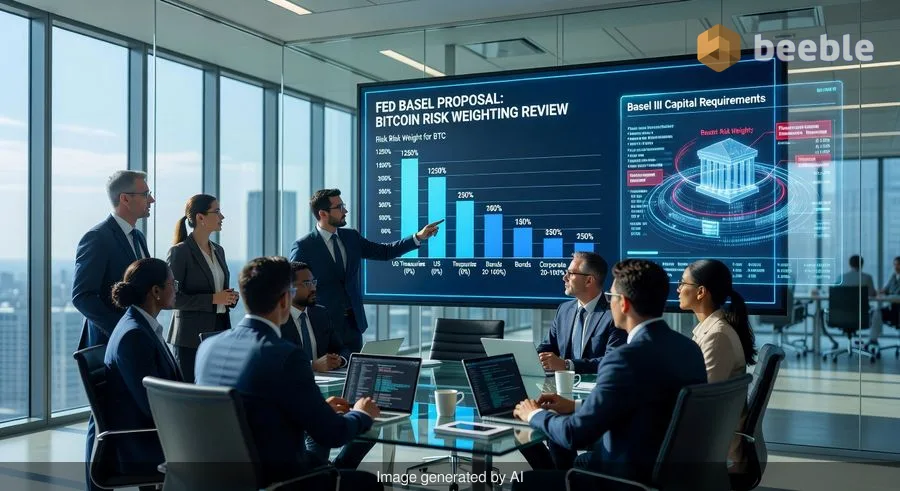
The intersection of legacy finance and digital assets is approaching a critical regulatory crossroads. Next week, the Federal Reserve is expected to unveil a formal proposal outlining how United States banks must handle Bitcoin and other crypto-assets on their balance sheets. This move, which implements the international standards set by the Basel Committee on Banking Supervision (BCBS), could dictate the pace of institutional Bitcoin adoption for the next decade.
At the heart of the debate is a technical metric known as "risk weighting." For the Bitcoin Policy Institute (BPI) and its leadership, including advocate Conner Brown, the upcoming 90-day public comment period represents a final opportunity to prevent Bitcoin from being regulated into a corner. The BPI argues that the current framework treats Bitcoin not as a revolutionary financial technology, but as a systemic hazard that banks should be discouraged from touching.
Understanding the Basel Framework and the 1250% Rule
To understand why the BPI is sounding the alarm, one must look at the mechanics of bank capital. Under the Basel III (and the evolving Basel IV) standards, assets are assigned a risk weight. This weight determines how much "buffer" capital a bank must hold against its holdings to protect against potential losses.
Most traditional assets have relatively low weights. For example, high-quality government bonds often carry a 0% weight, while residential mortgages might sit around 35%. Bitcoin, however, has been placed into "Group 2" by the Basel Committee, carrying a staggering 1250% risk weighting.
In practical terms, a 1250% risk weight is a "dollar-for-dollar" capital requirement. If a bank wants to hold $100 worth of Bitcoin, it must hold $100 of its own capital as a reserve. This makes Bitcoin significantly more "expensive" for a bank to hold than almost any other asset class. It effectively acts as a prohibitive tax on institutional custody and balance sheet exposure, making it difficult for banks to offer competitive services to Bitcoin-focused companies or retail investors.
The Bitcoin Policy Institute’s Mission
The Bitcoin Policy Institute views this classification as an outdated approach that fails to account for the unique properties of the network. According to Conner Brown, the institute intends to participate aggressively in the Fed’s comment period to ensure regulators "get Bitcoin’s treatment right."
The BPI’s argument generally centers on the idea that Bitcoin is a distinct asset class—a decentralized digital commodity—rather than a generic "crypto-asset" prone to the same risks as centralized tokens or failed stablecoin projects. By applying a blanket 1250% weight, regulators are ignoring the liquidity, transparency, and global market depth that Bitcoin has achieved over the last 17 years.
Why the Next 90 Days Matter
When the Federal Reserve issues its proposal next week, it won't just be a set of suggestions; it will be the blueprint for how the largest U.S. financial institutions interact with the digital economy. The subsequent 90-day comment period is a rare window where the public, industry experts, and policy groups can submit empirical evidence to sway the final ruling.
If the Fed adopts the Basel standards verbatim, U.S. banks may find themselves at a competitive disadvantage compared to international counterparts or non-bank fintech firms that operate under different capital mandates. This could push Bitcoin activity further away from the regulated banking system and into the "shadow banking" sector—the exact opposite of what many regulators claim to want.
Comparing Risk Weights: A Financial Perspective
To visualize the impact of these rules, consider how different assets affect a bank's capital requirements. The following table illustrates the disparity between Bitcoin and traditional assets under the proposed framework.
| Asset Type | Typical Risk Weight | Capital Required for $1M Exposure |
|---|---|---|
| Sovereign Debt (AAA) | 0% | $0 |
| Residential Mortgages | 35% | $28,000 (approx. 8% of weight) |
| Corporate Loans (BBB) | 100% | $80,000 |
| Bitcoin (Proposed) | 1250% | $1,000,000 |
As shown above, the 1250% weight is designed to be punitive. It reflects a regulatory philosophy of "high risk, high capital," intended to insulate the broader financial system from Bitcoin's price volatility. Critics, however, argue that this ignores the risk-mitigation strategies banks already use, such as cold storage, insurance, and sophisticated hedging.
Practical Takeaways for the Industry
As the Federal Reserve prepares to open the floor for discussion, stakeholders should prepare for a period of intense advocacy and technical debate. Here is what to watch for in the coming months:
- The Definition of "Group 2": Watch if the Fed creates a sub-category for Bitcoin that distinguishes it from other, more volatile or centralized digital assets.
- Custody vs. Proprietary Trading: There may be a push to lower risk weights for banks that are simply providing custody services (holding Bitcoin for clients) versus those holding it as a primary investment.
- The "Endgame" Alignment: This proposal is part of the broader "Basel III Endgame" in the U.S. Pay attention to how it aligns with other capital requirement changes that are currently facing pushback from the banking lobby.
- Public Participation: If you are part of a financial institution or a policy group, the 90-day window is the time to submit data-driven arguments regarding market liquidity and historical volatility to challenge the 1250% figure.
The Path Forward
The Federal Reserve’s upcoming proposal is more than just a technical update; it is a statement on where Bitcoin fits in the future of American finance. If the Bitcoin Policy Institute and its allies can successfully argue for a more nuanced risk-weighting, it could open the floodgates for U.S. banks to integrate Bitcoin into their core services. If the 1250% rule stands, Bitcoin will likely remain on the periphery of the traditional banking system, reserved for specialized players rather than the financial mainstream.
Sources
- Federal Reserve Board - About the Basel Committee
- Basel Committee on Banking Supervision - Crypto-asset standards
- Bitcoin Policy Institute - Official Website
- Office of the Comptroller of the Currency - Capital Rules



See you on the other side.
Our end-to-end encrypted email and cloud storage solution provides the most powerful means of secure data exchange, ensuring the safety and privacy of your data.
/ Create a free account
