


The Invisible Bridge in Your Wallet and the End of the Crypto Off-Ramp

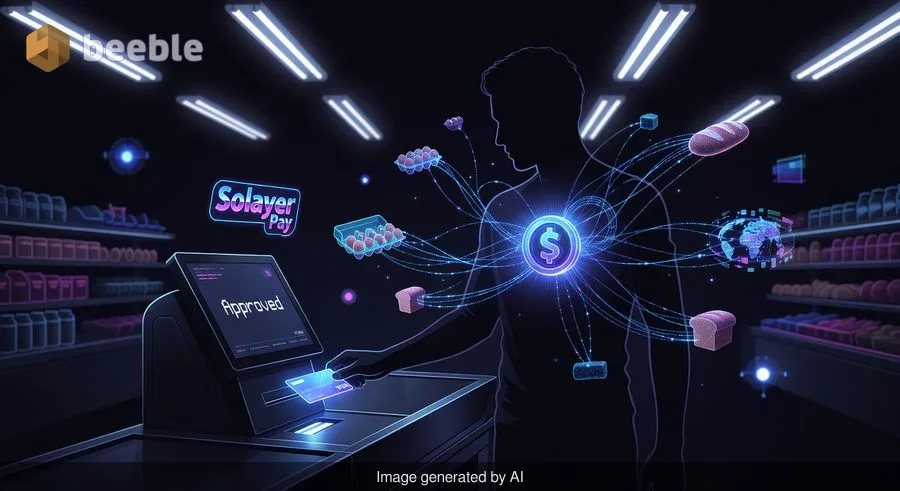
You are standing at a self-checkout kiosk, the fluorescent lights humming overhead, and your total comes to $14.52 for a carton of eggs and a loaf of bread. You reach into your pocket. You pull out a piece of plastic. It feels like every other card you have ever owned—the same weight, the same standard dimensions, the same embedded chip that waits for a handshake with the terminal. But as you dip the card, you aren't tapping into a traditional checking account backed by a local branch with marble pillars. Instead, you are triggering a sequence of events across a decentralized network that moves at the speed of light. Behind that simple 'Approved' message on the screen lies a profound shift in how we perceive the very nature of spendable wealth.
On May 14, 2026, the barrier between digital assets and daily bread became significantly more porous. Solayer Pay announced the launch of its physical Visa card, a tool designed to let users spend USDC—the world’s second-largest stablecoin—at any merchant or ATM that accepts Visa globally. For those who have spent years navigating the clunky, often anxiety-inducing process of moving funds from a digital wallet to a bank account just to pay for groceries, this isn't just a product launch. It is the quiet erasure of the 'off-ramp' as we know it.
The Friction of the Old World
Historically, the experience of holding crypto was defined by a frustrating paradox. On one hand, you held an asset in a transparent, glass bank vault—where you could see every cent and verify every transaction on a public ledger. On the other hand, that wealth often felt trapped behind a thick layer of institutional glass. To buy a cup of coffee, you had to sell your assets on an exchange, wait for the trade to settle, initiate a wire transfer to a legacy bank, and wait another 24 to 48 hours for the legacy system to recognize your own money as 'available.'
This friction wasn't just a technical hurdle; it was a psychological one. It reinforced the idea that digital currency was a speculative toy rather than a tangible tool for living. Consequently, many retail investors treated their digital wallets like a 'rainy day' fund that was perpetually stuck in a storm. Solayer’s physical card seeks to dismantle this mindset by integrating stablecoin spending into the mundane, repetitive rituals of our financial lives. By linking a Visa card directly to a Solayer Pay balance, the platform effectively turns a global blockchain into a local checking account.
The Mechanics of the Mundane
Behind the scenes of this trend, the technology required to make a sandwich purchase feel 'normal' is staggering. The Solayer card operates on the infiniSVM network, a Layer-1 blockchain infrastructure capable of processing 330,000 transactions per second. To put that in perspective, the time it takes for you to pull your card out of the reader—roughly 400 milliseconds—is the same amount of time the network needs to achieve finality.
Zooming out, this speed is the essential 'connective tissue' that allows a decentralized ledger to compete with the massive, centralized databases of traditional finance. When you swipe, the system isn't just checking if you have enough money; it is navigating a complex web of on-chain settlement layers and currency conversions in the blink of an eye. For the user, the experience is invisible. For the financial system, it is a radical departure from the batch-processing methods that have governed banking since the 1970s.
Existing Solayer Pay users, who may have already been using the virtual 'Emerald Card' since its debut in April 2025, receive this physical upgrade at no cost. For new entrants, the price of admission is a $20 annual activation fee. In an era where traditional banks are increasingly hiding fees behind 'premium' tiers or minimum balance requirements, a flat fee for global, borderless liquidity feels like a pragmatic trade-off for the modern consumer.
A Global Shift in Collective Belief
Financially speaking, the rise of the Solayer card is symptomatic of a much larger macroeconomic movement. As of May 2026, the total stablecoin market has swelled to $322 billion, a significant jump from $243 billion just one year prior. USDC alone commands roughly $78 billion of that market share. This growth isn't just a number on a chart; it represents a fundamental shift in trust.
Fiat currency has always functioned as a collective belief system, backed by the authority of governments and the stability of central banks. However, as inflationary pressure erodes the purchasing power of traditional currencies in fragmented economies across the globe, many individuals are looking for a more resilient alternative. Paradoxically, they aren't looking for the wild volatility of Bitcoin to pay their rent; they are looking for the stability of the dollar combined with the transparency and speed of the blockchain.
This is why we see giants like Visa and Stripe’s Bridge expanding their stablecoin card programs to over 100 countries. When institutional partners begin treating on-chain settlement as a primary option rather than a laboratory test, the 'digital wild west' starts to look more like a global utility. Visa’s own stablecoin settlement pilot has grown to $7 billion across nine different blockchains, signaling that the infrastructure is no longer experimental—it is foundational.
The Behavioral Trap of Convenience
As a journalist observing these cycles, I find the psychological impact on the ordinary retail investor to be the most nuanced part of this story. There is a certain financial empathy we must have for the user who finally feels 'safe' spending their USDC. For years, the industry relied on FOMO—the fear of missing out—to drive adoption. But real, pervasive adoption doesn't happen during a price pump; it happens when the technology becomes so boring and ubiquitous that we stop talking about it.
However, there is a subtle risk in this seamlessness. When our money becomes invisible—shifting from paper bills to digital digits to 'settlement layers'—we risk losing our tactile connection to our spending habits. Inflation is often described as an invisible leak in your wallet, but when that wallet is a digital app that handles everything automatically, the leak becomes even harder to spot. The ease of the Solayer card might solve the 'off-ramp' problem, but it doesn't solve the human tendency toward impulsive consumption in a high-speed world.
Reclaiming the Economic Narrative
Ultimately, the launch of the Solayer Pay Visa card tells us more about the future of the global financial architecture than it does about any single company. We are moving toward a world where the 'type' of money you hold matters less than the network it travels on. Whether you are holding a government-backed digital currency or a private stablecoin like USDC, the rails are becoming unified.
Through this economic lens, the physical card in your hand is a transitional artifact. It is a bridge from the world of leather wallets and paper receipts to a future of interconnected, programmable value. It offers a sense of tangible control in a market that often feels opaque and volatile.
Practically speaking, for the 40,000 users who previously relied on the virtual Emerald Card, this physical expansion represents a validation of their financial choices. It means their digital assets are no longer confined to the glowing screen of a smartphone. They can walk into a local pharmacy in a foreign country, buy medicine, and know that the transaction is being settled on a high-performance blockchain with the same reliability as a traditional bank.
As we navigate this transition, the best approach for the everyday reader isn't to get caught up in the technical specs of transaction speeds or market caps. Instead, it is to observe how these tools change your own relationship with money. Does having instant access to your digital assets make you feel more secure, or does it make you more prone to the emotional swings of the market? The bridge is now open; the question is where you choose to walk once you've crossed it.
Key Takeaways for the Mindful Spender
- The End of the Wait: Tools like Solayer Pay remove the 48-hour anxiety of the 'off-ramp,' making digital wealth instantly liquid.
- Infrastructure over Hype: The real story isn't the card itself, but the 330,000 TPS network that makes a crypto purchase feel as mundane as a standard bank swipe.
- Stablecoins as Utility: With a $322 billion market cap, stablecoins are shifting from 'trading collateral' to 'everyday currency' for millions globally.
- Mindful Liquidity: Just because you can spend your digital assets at the grocery store doesn't mean you should ignore the long-term impact of those transactions on your financial goals.
Sources
- Solayer Pay / GlobeNewswire Official Launch Announcement (May 14, 2026).
- DefiLlama Stablecoin Market Cap Indices (May 2026 Data).
- Visa Global Stablecoin Settlement Pilot Report (Institutional Data Q1 2026).
- infiniSVM Technical Whitepaper: Performance and Finality Specs.
- Stripe / Bridge Merchant Integration Roadmap (2026 Expansion).



See you on the other side.
Our end-to-end encrypted email and cloud storage solution provides the most powerful means of secure data exchange, ensuring the safety and privacy of your data.
/ Create a free account
