


Volkswagen is shrinking its way into a new era

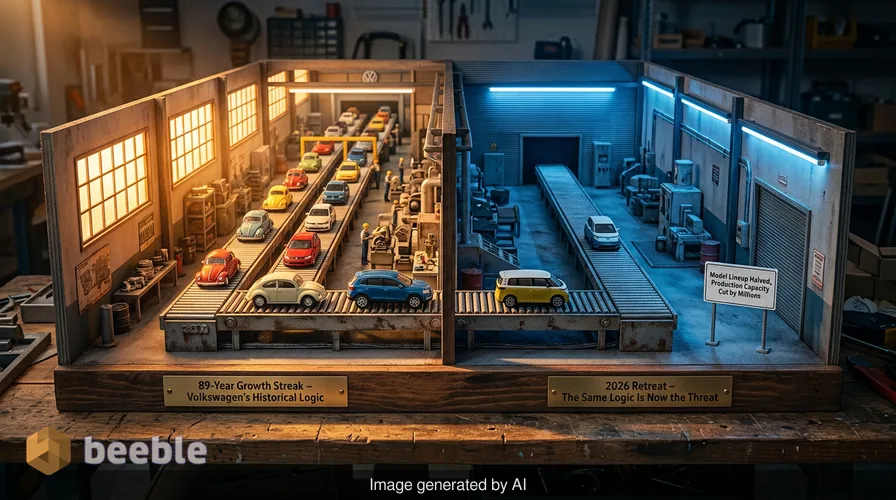
For decades, the story of Volkswagen was a story of expansion. Since the first Beetle rolled off the assembly line, the German giant followed a simple logic: build more cars, buy more brands, and occupy every possible niche in the market. This strategy turned the company into a global colossus with a dozen brands and a factory footprint that spanned the planet. However, the logic that built the empire is now the very thing threatening its survival.
Looking at the big picture, the automotive world is no longer a game of pure volume. The company is now reversing its historical trajectory. In a move that marks the end of its 89-year growth streak, Volkswagen is cutting its model lineup in half and shrinking its production capacity by millions of units. This is a fundamental retreat. Behind the jargon of efficiency overhauls and streamlined portfolios is a company that realized it grew too large for its own good in a world dominated by software and trade barriers.
A historical retreat from the global stage
To understand why this is happening, we have to look at the numbers that defined the old Volkswagen. Before the pandemic, the group had the capacity to build 12 million vehicles every year. It was a massive industrial machine designed for a world of open trade and endless demand. That world is gone. Today, the company is capping that capacity at nine million vehicles. It has already shed two million units of production capability. This change is not a temporary dip. It is a permanent downsizing.
Historically, Volkswagen used its massive scale to crush competitors. By sharing parts across brands like Seat, Skoda, and Audi, it saved money. But that scale became a trap. Having too many models meant the company was competing with itself. A customer might walk into a showroom and struggle to choose between three different SUVs that were essentially the same car with different badges. This complexity created a mountain of costs. Each model required its own marketing, its own spare parts supply chain, and its own regulatory testing.
Zooming out, the global market environment is now hostile to this old way of working. New tariffs on European cars in China and aggressive competition from low-cost manufacturers have made the volume game a losing battle. The company is now choosing to be smaller but more profitable. This is a survival tactic. By focusing on the segments where people spend the most money, Volkswagen hopes to fund the expensive transition to electric power.
The math behind the disappearing model list
For the average user, the most visible change will be a much shorter menu of cars. The plan to cut the model lineup by 50 percent means that dozens of familiar nameplates will simply vanish. If a car does not generate a healthy profit, it has no place in the new lineup. This likely means the end for experimental niche cars and small, low-margin hatchbacks that were once the backbone of the brand.
Complexity is also a target. Volkswagen intends to reduce equipment options by up to 75 percent. In the past, buying a German car was an exercise in choosing between fifty shades of grey upholstery and ten different wheel designs. This customization was a pride point for the brand, but it was a nightmare for the factory. Every unique combination of parts added time and error to the assembly line.
In everyday life, this means the car-buying experience will start to look more like buying a smartphone or a Tesla. You might have three trim levels and four colors to choose from. This streamlined approach reduces the number of unique parts the company has to keep in stock. It also makes the manufacturing process more resilient. When the supply chain for a specific type of seat heater breaks, it no longer halts production for the entire factory because everyone is using the same foundational components.
Closing the gates on the German industrial dream
Heavy industry is the invisible backbone of modern life, and for Germany, Volkswagen is the strongest vertebra in that spine. This makes the recent news of plant closures particularly shocking. The company is reportedly planning to cut 100,000 jobs, which is about 15 percent of its global workforce. Many of these cuts will happen in Germany, a country where the car industry and the state are deeply interconnected.
For years, closing a Volkswagen factory in Germany was considered impossible. The company’s board includes representatives from labor unions and the state government of Lower Saxony, creating a system designed to protect jobs at all costs. But the current economic pressure has broken that consensus. The German metalworkers union, IG Metall, has already staged massive protests at 18 sites. They see these cuts as a betrayal of the social contract that built the German economy.
Practically speaking, the company has no choice. It costs significantly more to build a car in Germany than it does in China or Eastern Europe. High energy costs and aging infrastructure have made German factories less competitive. By closing underperforming plants, Volkswagen is trying to protect its remaining operations. This is a systemic shift. The company is no longer an employment agency that happens to make cars. It is becoming a lean tech entity that prioritizes the balance sheet over industrial tradition.
Software as the new assembly line
One of the most complex parts of this overhaul involves things you cannot see. Volkswagen is merging its software, platforms, and electronic architecture divisions. Under the hood, modern cars are essentially computers on wheels, but Volkswagen has struggled to write the code that makes those computers work.
Previously, different brands within the group often developed their own software systems. This created technological parallel structures where two teams were solving the same problem at the same time. It was a waste of resources. By merging these divisions, the company aims to create a single digital brain for all its cars, from the cheapest hatchback to the most expensive luxury sedan.
This move is about unlocking synergies. If the software for the infotainment system is the same across 20 different models, the company only has to fix a bug once. It also allows for faster updates. In the past, updating a car’s software often required a trip to the dealership. The new architecture is designed for over-the-air updates, much like your phone. This is a foundational change for a company that spent 80 years perfecting the metal and only the last ten years worrying about the pixels.
What this means for your next car purchase
If you are planning to buy a Volkswagen in the next few years, the experience will be different. The bottom line is that cars will likely be more expensive. As the company abandons the low-profit volume game, it will lean into the premium market. You will see fewer basic models and more high-end SUVs.
On the market side, your choices will be simpler. While the loss of customization might annoy some enthusiasts, it should lead to better build quality. When a factory builds 500,000 identical cars instead of 500,000 unique ones, it gets very good at that one specific design. This reduces defects and improves reliability. Essentially, you are trading choice for consistency.
From a consumer standpoint, the software experience should also improve. VW’s previous attempts at digital interfaces were often criticized for being slow and buggy. By focusing all its engineering talent on a single platform, the company is finally treating software with the same seriousness it gives to engine displacement. Your next car will feel more intuitive because the people who built it stopped trying to reinvent the wheel for every different model.
A shift toward quality over quantity
Ultimately, Volkswagen is attempting a controlled demolition of its old self to build something that can survive the 2030s. The era of the all-encompassing industrial giant is fading. In its place is a more decentralized, agile company that values profit margins over production trophies. This transition is painful. It involves lost jobs, closed factories, and the disappearance of legendary car models.
As a user, this is a reminder that even the most robust institutions are subject to the cyclical nature of technology and trade. The car in your driveway is no longer just a piece of hardware. It is a node in a global digital network. Volkswagen’s decision to shrink is a recognition that you cannot win the future by holding onto the past. Observe how your own digital habits have shifted from owning physical media to streaming services. The auto industry is undergoing the same transition. It is moving from a world of physical abundance to one of digital efficiency. While the Volkswagen of tomorrow will be smaller, the company is betting that it will be resilient enough to stay on the road for another century.
Sources:
Volkswagen Group Newsroom, Executive Board Statement on Efficiency Programs.
IG Metall Union Press Release on Wolfsburg Demonstrations.
Federal Ministry for Economic Affairs and Climate Action, German Automotive Industry Report.
Association of the Automotive Industry (VDA) Market Data.



See you on the other side.
Our end-to-end encrypted email and cloud storage solution provides the most powerful means of secure data exchange, ensuring the safety and privacy of your data.
/ Create a free account
