


Why an AI agent paying for its own server space is the new macro-economic reality

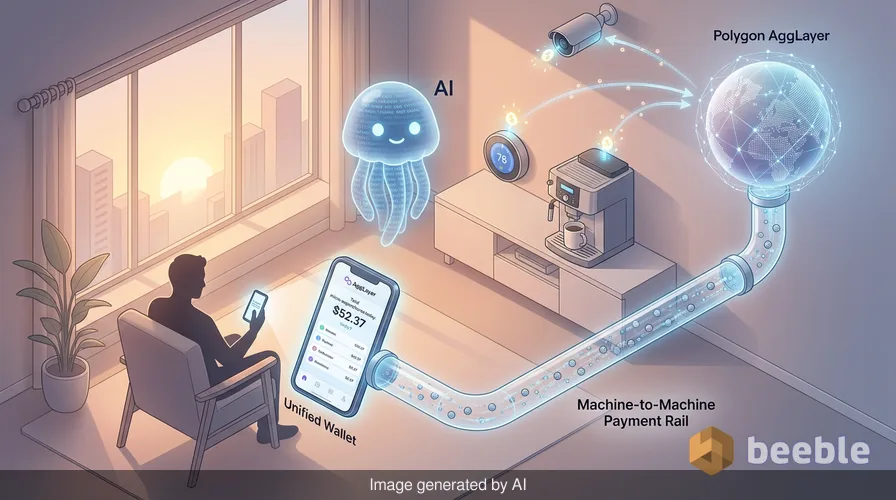
Have you ever wondered why your smart devices still require your thumbprint for every tiny purchase? Perhaps you have an automated coffee subscription that triggers a delivery when your bag gets low. You might think this is automation, but it is actually a clunky bridge between your digital habits and an ancient banking system. Your bank is a slow, guarded vault designed for a world where humans sign paper checks or tap plastic cards. This system fails the moment a software program needs to pay five cents for a better line of code or a faster processing unit. The current financial plumbing is too heavy for the nimble needs of artificial intelligence.
The friction in your digital wallet
Traditional payment rails like Visa or SWIFT are expensive. They charge flat fees that make micro-transactions impossible. If an AI agent needs to pay a fraction of a cent for a single API call, a thirty-cent transaction fee is a death sentence for that business model. Your bank account is also tied to your identity through a process called KYC, or Know Your Customer. A piece of software does not have a passport or a utility bill to prove its residence. It cannot open a checking account at a local branch. This creates a structural barrier between the smartest tools we own and the money they need to function.
Polygon functions as the alternative rail for this new economy. It is a decentralized network that allows for near-instant settlement at a cost that is often less than a penny. By using this blockchain, AI agents bypass the bottlenecks of the traditional retail banking sector. These agents move money through smart contracts, which are essentially digital agreements that execute automatically when certain conditions are met. This is the glass bank vault where the rules are transparent and the execution is mathematical.
How the AggLayer connects isolated islands of capital
Zooming out, the biggest hurdle for digital money has always been fragmentation. Every blockchain used to be an island, unable to talk to its neighbors without risky bridges. Polygon recently introduced the AggLayer to solve this specific problem. It acts as a unified layer that stitches different networks together into a single, cohesive environment. To put it another way, it is like the early days of the internet when different local networks finally adopted a common protocol to share data.
When an AI agent operates on the AggLayer, it does not care which specific sub-network it uses. It only cares that the transaction is valid and the liquidity is available. This is crucial for machine-to-machine commerce. If one AI agent is specialized in data analysis and another is specialized in creative writing, they can trade services and settle the bill in real-time. This happens without a central clearinghouse to slow the process down. The AggLayer provides the systemic glue for these transactions.
The macro shift toward machine-centric money
On a macro level, we are witnessing the birth of a machine-to-machine economy that operates independently of human work hours. Historically, the velocity of money was limited by how fast humans could spend it. We sleep, we hesitate, and we wait for paychecks. AI agents do none of these things. They can execute thousands of transactions per second, every hour of every day. This shift turns money into a pervasive utility rather than a manual tool.
Financially speaking, this creates a new kind of demand for digital assets. If millions of AI agents require a specific token to pay for their computational 'rent,' that token becomes a foundational piece of economic infrastructure. We are moving away from speculative digital coins and toward functional digital fuel. This is not a shift in price, but a shift in purpose. The tokens are no longer just assets to hold; they are the grease for the gears of global automation.
Why human psychology struggles with automated spending
Through this economic lens, the transition brings a new kind of financial anxiety. Most of us are used to checking a bank app to see where our money went. Paradoxically, we find comfort in the manual control of our spending, even if that control is an illusion. When we delegate financial authority to an AI agent, we lose that visceral connection to our capital. You might wake up to find your agent spent fifty dollars on various micro-services to optimize your home energy bill. While the outcome is beneficial, the loss of agency feels volatile to the human mind.
In everyday terms, this is the same feeling you get when a subscription you forgot about hits your account. Only now, that feeling is multiplied by a hundred small decisions made by code. We are entering an era where our personal finances are managed by a silent, invisible staff of digital workers. This requires a profound shift in how we think about trust. We are moving from trusting institutions like banks to trusting the code that governs the AggLayer.
The mundane reality of a decentralized future
In practice, this evolution will likely be quite mundane. You will not see the blockchain working behind the scenes. Instead, you will simply notice that your digital services are more interconnected and efficient. Your smart home will negotiate its own electricity rates with the grid. Your personal assistant will buy its own cloud storage when it runs out of space. You will pay for these things through a single, unified interface that hides the complex crypto mechanics underneath.
Ultimately, the success of Polygon as a payment rail depends on its ability to remain invisible. The most successful financial systems are the ones we take for granted. We don't think about the plumbing when we turn on the tap. We only care that the water flows. If Polygon can maintain its low costs and high speeds, it will become the default plumbing for the AI economy. It is a structural upgrade to a global system that was simply too slow for the future.
Reclaiming financial mindfulness in an automated age
As we observe these changes, it is important to reflect on our own relationship with money. The convenience of an AI-led economy is tangible, but it comes at the cost of direct oversight. We must decide which financial decisions we are willing to outsource and which we must keep for ourselves. Machine-to-machine payments are efficient, but they lack the human nuance of value. An AI knows the price of everything and the value of nothing.
Practically speaking, the best way to navigate this shift is to stay informed about the tools managing your wealth. Understand the protocols your agents use. Look for transparency in the smart contracts that hold your funds. While the machines handle the micro-transactions, humans must still provide the macro-direction. We are the architects of this new financial landscape, and our role is to ensure the machines work for our benefit, not just for their own efficiency.
Key takeaways for the digital transition
- Your traditional bank account is built for human speed, while AI agents require machine speed for micro-payments.
- Polygon provides the low-cost infrastructure needed for software to trade with other software without high fees.
- The AggLayer solves the problem of fragmented blockchains by creating a single environment for digital money.
- As spending becomes more automated, the psychological challenge is maintaining a sense of control over our capital.
- The most significant change is not the price of a coin, but the transition of money into an invisible utility for automation.
Sources
- Polygon Labs technical documentation on AggLayer architecture and zero-knowledge proof implementation.
- World Economic Forum report on the evolution of Agentic AI and autonomous economic actors (2025).
- Bank of International Settlements (BIS) quarterly review on the role of programmable money in retail markets.
- Economic research on the velocity of money in automated high-frequency trading environments.



See you on the other side.
Our end-to-end encrypted email and cloud storage solution provides the most powerful means of secure data exchange, ensuring the safety and privacy of your data.
/ Create a free account
