


Why is finding a hotel or flight in Europe suddenly so much harder?

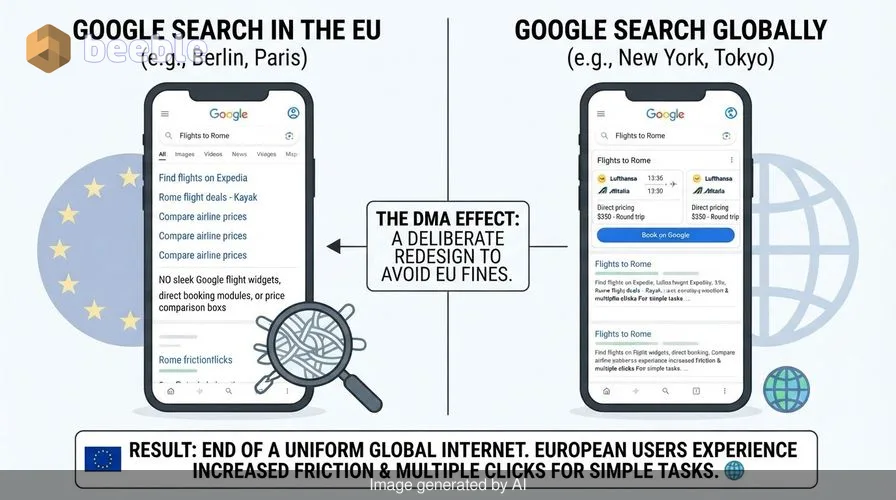
Why does finding a simple flight or a local restaurant feel like a chore for millions of internet users in Europe today? If you live in Berlin or Paris, your search results no longer look like the ones in New York or Tokyo. The sleek boxes that once showed you the price of a hotel room or the time of a flight have vanished. In their place is a series of links that lead to other links. This shift is not a glitch in the system. It is a deliberate redesign by Google to avoid massive fines from the European Union.
For nearly three decades, the world has viewed the internet as a global, uniform space. That era is ending. The web is becoming a series of rooms with different rules. In the European Union, the Digital Markets Act (DMA) has forced Google to change how it presents information. The goal of the regulation is to stop big tech companies from favoring their own services. However, the immediate result for the person typing into the search bar is a noticeable increase in friction. Simple tasks that used to take seconds now require multiple clicks and retyped queries.
The digital concierge loses its voice
To understand this change, think of Google as a digital concierge at a large hotel. In the past, if you asked for a restaurant recommendation, the concierge gave you the address, a phone number, and a direct way to book a table. The European Commission viewed this as unfair. They argued the concierge was only recommending the hotel's own restaurant or businesses that paid for a spot. The new rules essentially tell that concierge to stop giving direct answers. Instead, the concierge must point you to a shelf of phone books and brochures from other booking agencies.
On the market side, this is a win for companies like Expedia and Booking.com. These businesses are known as vertical search services. They act as middle players between you and the airline or hotel. Before these changes, Google displayed its own comparison tools at the top of the page. Now, those tools are gone or stripped of their best features. A carousel of hotels that once showed real-time prices has been replaced by a list of three or four other search engines. You must click one of those engines to finally see the prices you want.
This change adds a layer of separation between the consumer and the service provider. For the average user, the search engine is less of a tool for answers and more of a directory of other directories. This is what Nick Fox, Google’s senior vice-president for knowledge and information, refers to as a reduction in the quality of service. From a consumer standpoint, the internet has become less intuitive.
The real cost of leveling the playing field
Looking at the big picture, these changes have a tangible impact on small, local businesses. Google reports that past tweaks to comply with the DMA led to a 30% drop in free, direct booking traffic for European companies. This happens because the direct links to a small hotel's website or phone number are now buried under the big aggregators. If a local bed-and-breakfast loses that direct link, they have to rely on sites like Booking.com to find customers. These sites often charge a commission on every booking.
When a user finds a hotel through an intermediary instead of directly, the small business loses a chunk of its profit to the middleman. Paradoxically, a law designed to help small companies compete with big tech is currently driving traffic toward other massive corporations. The local hotelier in Rome or the independent cafe in Madrid is finding it harder to reach their customers without paying a toll to a third-party platform. This shift represents a systemic change in how digital traffic flows through the economy.
In everyday life, this means you are less likely to find the lowest price on your first try. When you are forced to use an intermediary site, you are seeing a version of the market filtered by that site's own algorithms and fees. Historically, Google used its own data to show you the best price immediately. Now, that data is tucked away to ensure that Expedia and its peers get a fair shot at your click.
A decade of legal combat
This specific update is the latest chapter in a long-running battle. Google has accumulated over 10 billion Euros in antitrust penalties from the European Union over the last twenty years. The most recent fine of 460 million Euros in July focused on how Google displayed shopping and travel results. The regulators gave the company 60 days to comply or face even heavier penalties. These penalties can reach 5% of the company's total worldwide turnover, which is a sum large enough to move the needle on a global stock exchange.
Alphabet, Google's parent company, is caught between a rock and a hard place. If they keep the search engine easy to use, they pay billions in fines. If they comply with the law, they break the product that millions of people use every day. The company has tested these new results with millions of users and found high levels of dissatisfaction. People do not like being forced to do more work to get the same result.
Curiously, this creates a divide in the user experience based on geography. If you are a traveler from the United States visiting London, your phone will start showing you these degraded results as soon as you connect to a local network. Users outside the EU are not affected, which highlights how the internet is being partitioned by legal borders. The foundational idea of a seamless digital world is being replaced by a fragmented one.
What this means for your digital habits
Practically speaking, you need to change how you search if you are in Europe. Because the top of the page is now dominated by intermediaries, you will likely see more ads and more aggregator links before you find what you actually need. Zooming out, this is a reminder that the convenience of modern tech often relies on a delicate balance of data sharing and competition. When that balance shifts, the consumer is usually the one who pays in time or money.
Behind the jargon of the Digital Markets Act is a fundamental question about who owns your attention. The EU believes that by breaking Google's grip on the search page, they are protecting the future of the internet. They want to ensure that the next great search startup has a chance to be seen. Google argues that they are simply being punished for building a product that people prefer to use.
For the person trying to book a weekend trip, the debate is secondary to the frustration of a slower interface. You might find yourself going directly to airline apps or bookmarking your favorite hotel sites to avoid the search engine altogether. This behavior is exactly what the regulators want to see. They want to break the habit of using Google for everything.
Ultimately, the bottom line is that the digital world is no longer a neutral utility. It is a highly regulated space where your experience is shaped by the tension between corporate power and government oversight. As these rules evolve, the invisible mechanics of the web will continue to surface in the form of extra clicks and missing features. The search bar is no longer just a window to the world. It is a mirror of the legal battles happening behind the scenes.
Key takeaways for the savvy user
To manage this new environment, consider these practical shifts in your online behavior:
| Action | Reason |
|---|---|
| Use direct bookmarks | Bypassing search saves time and helps local businesses avoid paying commissions to aggregators. |
| Check multiple sources | The top results are now legally required to be intermediaries, so the first price you see might not be the best one. |
| Use specific search terms | Adding the name of a city or a specific brand helps cut through the generic aggregator links. |
| Expect more friction | Searching for local services in the EU now takes more steps than it did a year ago. |
Looking ahead, other regions may follow Europe's lead. If these regulations are deemed successful in curbing big tech power, the frictionless search experience we once took for granted might become a relic of the past. For now, the best strategy is to be aware of why your screen looks different and to take the extra few seconds to find the direct path to the businesses you want to support.
Sources: Reuters Business News, Alphabet Investor Relations, European Commission Digital Markets Act Compliance Reports, Google Search Quality Update Documentation.



See you on the other side.
Our end-to-end encrypted email and cloud storage solution provides the most powerful means of secure data exchange, ensuring the safety and privacy of your data.
/ Create a free account
