


Why Tom Holland saying my dad explains our obsession with museum-grade cinema

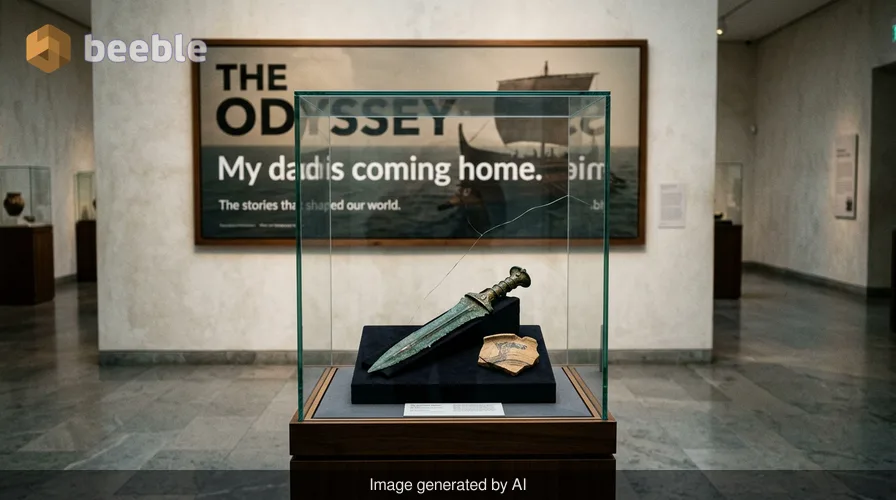
The collective wince felt across the internet when the first trailer for Christopher Nolan’s The Odyssey dropped was a specific kind of cultural pain. It was the sound of a thousand historical expectations shattering at once. When Tom Holland, playing Telemachus, looked Robert Pattinson’s Antinous in the eye and said, “my dad is coming home,” the reaction was visceral and immediate. This reaction was the emotional equivalent of seeing a coffee cup left on a table in a medieval fantasy drama. From a creator's standpoint, this friction was intentional. Nolan traded linguistic period-accuracy for immediate emotional recognition.
Behind the scenes, the decision to use contemporary dialogue was a calculated move to strip away the museum glass that separates modern audiences from the ancient world. We have been conditioned to believe that people in the Bronze Age spoke in the same way they do in Victorian translations of Homer. We expect a certain Shakespearean weight to the vowels and a formal distance in the sentence structures. Consequently, hearing a teenager use the word “dad” feels like a breach of contract. Nolan argues that this contract was built on a foundation of cultural prejudice and aesthetic tropes rather than historical reality.
The architecture of a mythic foundation
World-building operates as an architectural foundation for any epic film. If one pillar feels out of place, the entire structure of immersion can collapse for a skeptical viewer. Many audiences view the ancient world as a place of white marble, flowing robes, and constant gravitas. Nolan identifies this as a leftover from the Romantic era of art. In that period, painters depicted the Greeks as statuesque figures wrapped in bedsheets. This image has become the default setting for the genre. Paradoxically, the actual archaeology of the Mycenaean period suggests a world that was far more colorful and utilitarian.
When Nolan speaks about doing away with these assumptions, he is addressing the invisible filters we apply to history. We tend to elevate the past because it is old. We treat the characters of The Odyssey as if they knew they were in a classic poem. This creates a distance that prevents the audience from feeling the urgency of the stakes. Telemachus is a young man whose house has been invaded by men who want to marry his mother and kill him. In that moment of confrontation, a formal address like “my father” might convey a sense of nobility, but “my dad” conveys a sense of personal loss and a threat that is easy to understand.
The battle over blackened bronze and batman helmets
The controversy surrounding The Odyssey is about more than just words. It is about the physical texture of the world. When the debut trailer revealed Agamemnon in a suit of all-black armor, the internet compared the look to Nolan’s work on the Dark Knight trilogy. Critics pointed to the lack of historical evidence for such designs. They asked why the ships looked like Viking vessels and why the helmets had a modern, aggressive silhouette. Through this audience lens, the film appeared to be prioritizing a superhero aesthetic over the realities of the late 13th century BC.
Nolan defended these choices by pointing to the gaps in the archaeological record. Our knowledge of the Bronze Age collapse is based on fragmentary evidence. This lack of certainty provides a creative space for speculation. Costume designer Ellen Mirojnick utilized the theory of blackened bronze to distinguish Agamemnon from the common soldiers. This process involved adding gold and silver to bronze and treating it with sulfur. The result is an armor that looks expensive and intimidating. It communicates status through materials that were accessible at the time. Essentially, the goal was to create a world that felt credible to the people living within it, rather than a world that looks like a history textbook.
Using familiar faces to ground ancient gods
Casting is the most powerful tool a director has to make an alien world feel domestic. Nolan chose actors like Lupita Nyong’o, Jon Bernthal, and Zendaya because they carry a specific cultural weight. Zendaya as Athena or Bernthal as Menelaus brings a modern energy to these mythological figures. When an audience sees a face they recognize from contemporary media, it creates an anchor. It makes the story feel like it is happening now, rather than thousands of years ago.
This strategy is similar to the one Nolan used in Interstellar. In that film, he used real-world physics and speculative science to make a journey through a black hole feel grounded. He faced complaints from scientists who disagreed with the creative liberties taken for the sake of the narrative. Now, he faces similar complaints from historians and linguists. In both cases, the objective was the same. He wanted to use the best speculation available to create a world that feels vital and exciting. The familiar faces of the cast help bridge the gap between the audience's daily lives and the high-stakes drama of a mythic epic.
The paradox of historical accuracy in fiction
There is a strange irony in the demand for historical accuracy in a story about a man who fights a Cyclops and hears the song of the Sirens. The Odyssey is a myth, yet we hold its visual and linguistic presentation to the standards of a documentary. This reflects a larger trend in the entertainment industry where fans demand a high degree of realism in speculative genres. We want our dragons to have realistic wing spans and our ancient Greeks to speak in a way that sounds old. This desire for realism is often just a desire for familiar tropes.
Nolan’s rejection of these tropes is a gamble on the audience's ability to adapt. He admitted to the Los Angeles Times that this approach might fail. He chose an earthy narrative because he believes it has more emotional meaning than an intellectual one. For him, the question was never about what word a person in 1200 BC would have used. The question was what word would convey the right emotion to a person in 2026. This focus on the human experience over the academic one is what defines his version of the story.
Reclaiming the grit of the bronze age
At its core, The Odyssey is a story about a family trying to reunite in a broken world. The Bronze Age collapse was a period of societal failure and chaos. It was not a time of pristine marble temples. It was a time of mud, bronze, and blood. By stripping away the formal language and the idealized imagery, Nolan is attempting to return the story to its original roots. The first audiences who heard Homer’s poem would have recognized the world he described. It would have felt contemporary to them.
Zooming out to the industry level, this film represents a shift away from the legacy of the Hollywood epic. For decades, we have been stuck in a cycle of imitating the movies that came before us. We make historical films that look like other historical films. Nolan is trying to break that cycle by looking directly at the archaeology and the raw emotion of the text. Whether the audience accepts Tom Holland saying “dad” will depend on whether they can let go of their own cultural prejudices.
In everyday terms, we should observe how we consume our history. We often prefer the polished version of the past because it is comfortable. It fits into the categories we have already created in our minds. When a piece of media challenges those categories, it forces us to reconsider what we think we know. The Odyssey is a reminder that the people of the past were just as messy and modern as we are today. They had fathers and mothers, not just kings and queens. They lived in a world that was as vital and credible to them as ours is to us.
Ultimately, the success of Nolan's vision will not be measured by the accuracy of the armor or the choice of a specific noun. It will be measured by the audience's ability to see themselves in the reflection of the ancient world. If the film can make us feel the desperation of Odysseus or the hope of Telemachus, then the language has done its job. We are invited to step out of the museum and into the world as it was lived. It is an invitation to see the past not as a collection of artifacts, but as a living, breathing reality.



See you on the other side.
Our end-to-end encrypted email and cloud storage solution provides the most powerful means of secure data exchange, ensuring the safety and privacy of your data.
/ Create a free account
