


Why your company's secret algorithm is harder to sue than your boss

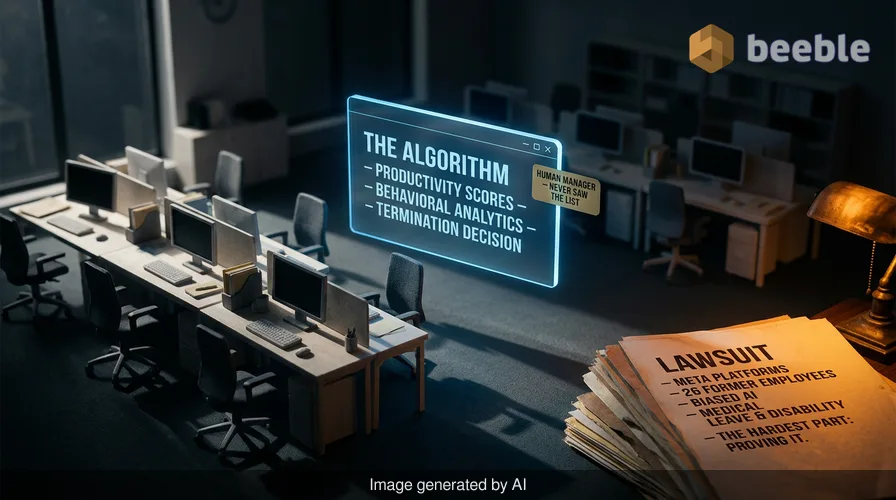
Here is the reality that tech giants prefer you ignore. When a company lays off thousands of people, you might assume a human manager reviewed your file, weighed your contributions, and made a difficult choice. In the modern workplace, a digital ghost often performs that triage instead. This ghost consists of lines of code, productivity scores, and behavioral analytics that decide your professional fate before a human ever sees the list.
A recent lawsuit against Meta Platforms reveals the steep mountain workers must climb when they suspect an algorithm discriminated against them. Twenty-six former employees claim Meta relied on biased artificial intelligence to select people for termination. These workers allege the systems targeted individuals who took medical leave or had disabilities. However, their struggle in court shows that while an AI might fire you, proving it is the hardest part of the process.
The hurdle of the locked room
In a recent ruling, U.S. District Judge William Orrick identified the central problem for these plaintiffs. He noted that the workers simply were not in the rooms where the decisions happened. This phrase refers to the burden of proof. In a standard discrimination case, a worker needs evidence that a human manager held a bias or made a specific, unfair comment. When an AI is involved, that evidence is buried inside proprietary software that the company owns and guards.
Meta maintains that humans made every decision regarding the 8,000 layoffs announced earlier this year. The company denied using AI token usage or performance scores as the basis for firing people. Because the plaintiffs cannot see the internal code or the exact datasets Meta used, they struggle to provide facts that contradict the company's version of events. The law requires a plaintiff to show a plausible link between the technology and the harm. Without access to the software, that link remains invisible.
The silent barrier of arbitration agreements
Most employees at large firms sign a stack of documents on their first day without a second thought. Hidden in that paperwork is often an arbitration agreement. This clause is a legal contract where you give up your right to sue in public court. Instead, you agree to settle disputes through a private process with a paid arbitrator.
Arbitration functions like a private shadow court. It is confidential, which prevents the public from seeing evidence of corporate wrongdoing. For the Meta workers, this agreement is a massive roadblock. It prevents them from forming a class action, which is when a large group of people sues together to share the cost and power of a lawsuit. When workers must fight alone in a private room, the company maintains the upper hand.
| Feature | Public Court Case | Private Arbitration |
|---|---|---|
| Transparency | Records are public and searchable. | Proceedings are private and confidential. |
| Precedent | Rulings help define future laws. | Decisions rarely influence other cases. |
| Collective Action | Workers can join together in class actions. | Usually requires individual, one-on-one claims. |
| Discovery | Broad access to company documents. | Limited exchange of information. |
| Cost | Can be expensive, but lawyers often take a cut of the win. | Often faster, but lacks the leverage of a jury. |
How algorithms track your every move
The lawsuit describes a workplace where every keystroke is a data point. The plaintiffs claim Meta used an internal assistant called Metamate and an employee-trained "second brain" to monitor communication and document usage. They also allege the company used productivity scores drawn from screen content, emails, and browser history.
If these claims are true, the AI might have flagged anyone who was away from their keyboard as "unproductive." For a worker taking protected family leave or managing a chronic illness, these gaps in data are not signs of poor performance. They are legally protected absences. The danger of AI is its inability to understand context. It sees a drop in tokens or activity and assigns a low score. The human who eventually signs the layoff notice might only see that score, not the medical reason behind the dip.
The one-way mirror of corporate data
The technology acts as a one-way mirror. The company can see everything the employee does, but the employee cannot see how the company interprets that data. Lawyers for the Meta workers even asked current and former employees to come forward with information. This move shows how desperate the search for evidence becomes when the decision-maker is a piece of software.
Meta holds virtually all the information regarding the layoff selection process. Under the current legal framework, a judge is often bound to take the company at its word unless the workers can find a whistle-blower or a leaked document. The burden of proof acts like a heavy backpack that the employee must carry uphill while the employer holds the keys to the evidence locker.
Why the expected wave of lawsuits is a ripple
Legal analysts expected a flood of AI-related employment lawsuits by now, yet very few have reached the courtroom. The Meta case is a rare exception. Another notable case involves Workday, a company that provides HR software to other businesses. Applicants claim Workday’s tools filtered them out based on race, age, and disability. That case is moving forward because job applicants usually haven't signed arbitration agreements with the software provider.
For current employees, the situation is much more precarious. The combination of secret algorithms and mandatory arbitration creates a fortress around corporate decision-making. If you cannot see how the AI works and you cannot go to a public court to find out, your rights exist only on paper.
How to protect yourself in an AI-driven workplace
While the legal system catches up to technology, you can take steps to build your own record. Do not wait for a layoff to consider how your performance is being measured.
- Request your data. Many states, including California, have laws that allow employees to see their personnel files and the data a company collects on them. Use these requests to see if you have an internal productivity score.
- Document your leaves. If you take time off for medical reasons or family care, keep a paper trail of the approval. If you are later told your "metrics" are down, you have proof that the metrics are tied to a protected activity.
- Read your contracts. Look for the word "arbitration" in your employment agreement. Knowing you have signed away your right to a jury trial is the first step in planning a different strategy for dispute resolution.
- Save performance reviews. Print or save copies of positive reviews from human managers. If an AI later marks you as a bottom-tier performer, the contradiction between human praise and algorithmic data is vital evidence.
The Meta case is not over. Judge Orrick will decide in late August whether to issue a preliminary injunction. If he does, it would be a landmark moment for workers' rights. For now, it serves as a warning that in the age of automation, the most important part of your job might be the data you leave behind.
Sources
- U.S. District Court for the Northern District of California: Meta Platforms Layoff Litigation
- Fair Labor Standards Act (FLSA)
- Americans with Disabilities Act (ADA)
- Federal Arbitration Act (FAA)
- California Consumer Privacy Act (CCPA) regarding employee data access
Disclaimer: This article is for informational and educational purposes only. It does not constitute formal legal advice. Laws regarding AI and employment are evolving rapidly and vary by state. If you believe you have been unfairly terminated or discriminated against, you should consult with a qualified attorney in your jurisdiction to discuss the specifics of your situation.



See you on the other side.
Our end-to-end encrypted email and cloud storage solution provides the most powerful means of secure data exchange, ensuring the safety and privacy of your data.
/ Create a free account
