


American cities are pulling the plug on Flock Safety cameras at a record pace

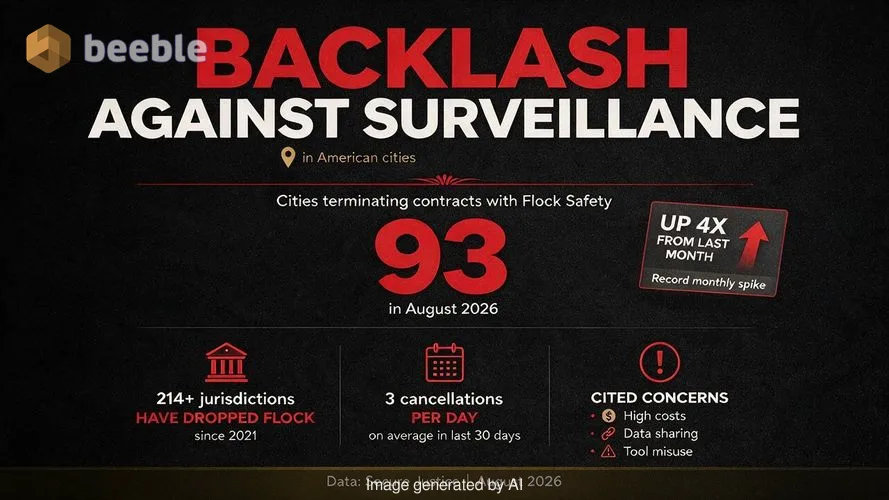
During the final weeks of August 2026, the rapid expansion of private surveillance networks in American neighborhoods encountered a significant obstacle. Local governments that once rushed to install automated license plate readers (ALPR) are now retreating from these contracts with surprising speed. New data shows that 93 cities and counties terminated their relationship with Flock Safety in August alone. This figure represents a fourfold increase compared to the previous month and establishes a new record for contract cancellations within the industry.
Since 2021, at least 214 jurisdictions have dropped Flock Safety from their public safety budgets. The pace is no longer a slow trickle. Over the last 30 days, an average of three localities per day halted their contracts. Communities from Lansing, Michigan, to Pflugerville, Texas, cite a consistent list of grievances including high expenses, unwanted data sharing, and reports of police officers abusing the surveillance tools for personal reasons.
Secure Justice, an Oakland-based advocacy group, compiled this latest data. Brian Hofer, the executive director of the group, observed that the cancellation rate has gone parabolic. Hofer, who chaired the Oakland Privacy Advisory Commission for a decade, noted that 165 of these cancellations occurred within the first eight months of 2026. If this momentum continues for another year, the financial impact on the surveillance industry will be significant. The number of cities opting out is growing fast.
why cities are walking away from the digital dragnet
The move to cancel these contracts is rarely about a single technical failure. It is a reaction to the systemic risks inherent in mass surveillance. For many city councils, the primary concern is the transformation of public roads into a digital dragnet. A digital dragnet is a surveillance system that collects information on everyone in an area regardless of whether they are suspected of a crime. When a city installs hundreds of cameras that log every vehicle, they create a comprehensive map of every resident’s movements.
Flock Safety markets its technology as a tool to solve crime by capturing license plates and vehicle characteristics. However, the data generated by these cameras is often shared with hundreds of other law enforcement agencies across state lines. A small police department in a rural town can theoretically access the travel history of a driver in a city hundreds of miles away. This lack of granular control over data dissemination has caused friction between local officials and the company. Granular control is the ability to manage specific, individual pieces of data or permissions rather than applying a single rule to everything.
Costs also play a role in the sudden exodus. The subscription model for these cameras requires recurring payments that can reach hundreds of thousands of dollars annually for a medium-sized city. As municipal budgets tighten, the high price of maintaining a private surveillance network becomes a precarious line item. Many local leaders now question whether the reported crime-solving statistics justify the long-term financial burden.
how artificial intelligence turned plate readers into mass surveillance
The technology has evolved far beyond simple plate recognition. Older systems functioned like a digital filing cabinet for license numbers. Modern systems powered by artificial intelligence function more like a search engine for the physical world. Jake Laperruque of the Center for Democracy and Technology noted that AI allows these camera networks to be searched for specific keywords, people, or even driving patterns.
In some jurisdictions, Border Patrol uses AI to scan ALPR data for driving patterns that the software deems suspicious. This shift from reactive investigation to proactive, automated profiling raises serious due process concerns. When an algorithm decides that a driver’s route is suspicious, it triggers a police stop without a specific human observation of a crime. This process treats every driver as a potential data point in a vast experiment.
Furthermore, some cities are incorporating real-time facial recognition into their existing camera networks. This turns a tool designed for vehicle identification into a system for tracking individuals on foot. The regulatory landscape for this type of integration is a patchwork quilt of inconsistent local laws. In practice, the technology often outpaces the legal frameworks meant to constrain it.
a rare moment of bipartisan political alignment
Concerns about surveillance are bridging the traditional political divide in Washington and state capitals. Senator Josh Hawley recently announced an investigation into how Flock Safety collects and retains data. His inquiry focuses on the dissemination of data generated by artificial intelligence. At the same time, Republican Governor Ron DeSantis of Florida publicly criticized the tech after two police officers were arrested for misusing the system. DeSantis described the cameras as out of control in his state.
One specific incident involved a police officer using the Flock network to track an ex-girlfriend. This type of stalking is not an isolated occurrence. In Texas, a Sheriff’s Office used the surveillance data to search for a woman who had sought an abortion. These incidents demonstrate that technical safeguards are often insufficient to prevent human abuse of the system. Terms of service may prohibit harassment, but they cannot physically stop a person with administrative access from typing a name into a search bar.
Flock Safety CEO Garrett Langley recently published a blog post addressing these criticisms. The company is reducing its default data retention period from 30 days to seven days. They also modified their terms of use to expressly prohibit users from using the service to harass or stalk others. While these changes represent a shift toward data minimization, they have not yet stopped the wave of contract terminations. Data minimization is the principle that a company should only collect and keep the smallest amount of personal information necessary to perform a specific task.
the legal risks of automated data sharing
From a compliance standpoint, the massive sharing of ALPR data creates a liability nightmare for local governments. When a city shares its camera feed with a third party, it loses control over how that data is protected or used. If the third-party agency suffers a data breach, the originating city may still face legal scrutiny from its residents. Data breaches are like an oil spill; once the information is out, it is nearly impossible to clean up or retract.
Some legal scholars argue that the continuous tracking of a citizen’s vehicle violates the Fourth Amendment’s protection against unreasonable searches. While a single photo of a car on a public street is generally legal, the aggregate data of every trip a person takes over a month creates a detailed profile of their private life. It reveals their place of worship, their doctor’s office, and their political affiliations.
UC Berkeley law professor Catherine Crump noted that this is a Silicon Valley product that threatens to reshape lives without public consent. The pushback in August 2026 suggests that the public is finally demanding a seat at the table. Communities are choosing to prioritize the right to be left alone over the promise of automated security.
steps for evaluating surveillance contracts
For cities still using these systems, or for residents concerned about their local implementation, several actionable steps can improve oversight.
First, audit the data sharing list. Every jurisdiction should maintain a public list of every other agency that has access to its camera data. Transparency is the only way to prevent shadow data sharing.
Second, mandate strict data retention limits. There is rarely a legitimate law enforcement reason to keep the location data of innocent drivers for more than 48 hours. Reducing retention periods significantly lowers the risk of the data being used for retrospective stalking or profiling.
Third, implement independent oversight. Police departments should not be the only ones monitoring their use of surveillance tools. A civilian privacy board should have the authority to review audit logs and investigate claims of misuse.
Finally, communities must hold public hearings before any new surveillance technology is purchased. Privacy is not a one-time transaction. It is a continuous negotiation between the government and the governed. The record number of cancellations in August shows that many communities have decided the current terms of that negotiation are no longer acceptable.
Sources: U.S. Constitution Fourth Amendment, Secure Justice Data Report (August 2026), Center for Democracy and Technology Security and Surveillance Project Guidelines.
Disclaimer: This article is for informational and journalistic purposes only. It does not constitute formal legal advice or a professional legal opinion.



See you on the other side.
Our end-to-end encrypted email and cloud storage solution provides the most powerful means of secure data exchange, ensuring the safety and privacy of your data.
/ Create a free account
