
How Mastercard is making the difference between your bank account and crypto wallet disappear

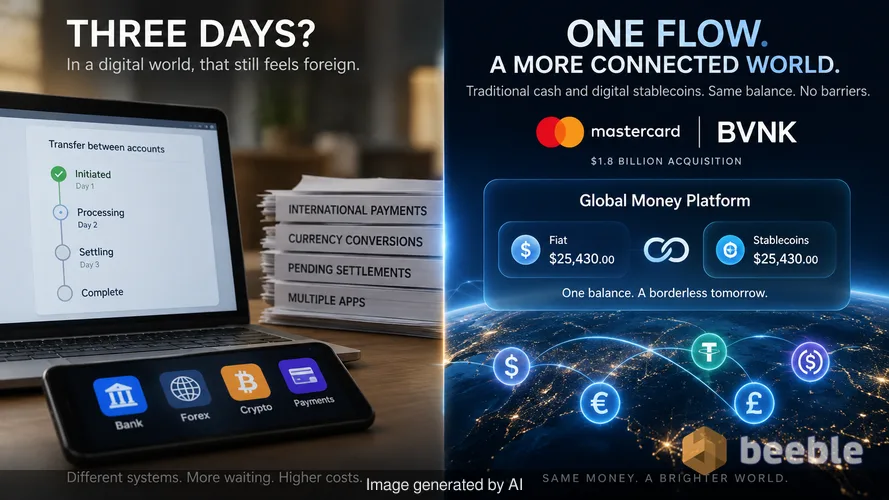
Why does it take three days for a bank to realize you moved money from one account to another? The digital age promised instant results. Instead, we got faster emails and the same slow wires. This delay is a relic of a fragmented banking system. We feel this friction every time we pay an international invoice or wait for a holiday refund to clear. Money is supposed to move at the speed of a text message. It rarely does. We wait for settlements. We pay for conversions. We navigate different apps for different currencies. These hurdles exist because our traditional financial systems speak a different language than the new world of digital assets.
Mastercard is now attempting to fix this plumbing through its $1.8 billion acquisition of BVNK. This move resulted in the launch of the Global Money Platform. This infrastructure layer allows banks and businesses to treat traditional cash and digital stablecoins as part of the same balance. It removes the invisible wall that separates your checking account from your digital wallet. By integrating these two worlds, the company is betting that the future of money is not a choice between crypto or fiat. It is a world where both coexist in a single, invisible flow.
The hidden machinery behind your next international payment
The Global Money Platform functions as a translation layer between traditional ledger systems and distributed blockchain networks. It uses a single API to connect a business's existing infrastructure to a multi-currency account. This account acts as a dual-purpose container. One side holds fiat currencies like dollars or euros. The other side holds stablecoins, which are digital tokens pegged to the value of those same currencies.
When a company uses this system, they no longer need to manage separate vendors for crypto and banking. The platform handles the conversion behind the scenes. This is the financial equivalent of a universal travel adapter. In the past, moving money from a stablecoin balance into a local bank account required multiple steps, several fees, and a fair amount of patience. Now, the system ties directly into Mastercard Move. This network handles the heavy lifting of sending local-currency payouts to recipients in over 200 countries.
Financially speaking, this is about liquidity. Liquidity describes how easily you can spend an asset without it losing value in the process. For years, crypto was an illiquid island. You could own it, but you could not easily buy a sandwich with it. By allowing stablecoin balances to be spent across its merchant network, Mastercard provides the bridge that turns a digital asset into a liquid one. Practically speaking, this means a worker in a different country could receive their salary in a stablecoin and spend it at their local grocery store using a standard debit card.
Why trust is the final frontier for digital assets
Historically, fiat currency is a collective belief system. We trust the paper in our pockets because we trust the institutions that issue it. This trust is deeply rooted in centuries of legal and military power. Paradoxically, many early crypto enthusiasts wanted to replace this trust with code. They described the blockchain as a glass bank vault. In this metaphor, everyone can see the money inside the vault, but only the owner has the key. While the transparency is clear, the average person finds the prospect of managing their own vault keys terrifying.
On an individual level, we prioritize convenience and safety over ideological purity. This is why the integration of BVNK matters. Most people do not want to be their own bank. They want the protections of a bank with the speed of a blockchain. By putting its brand name on stablecoin infrastructure, Mastercard provides a layer of institutional comfort. It signals that digital dollars are no longer just for speculators in the digital wild west. They are now a systemic part of the global payments empire.
Curiously, this shift happens as our physical wallets are becoming lighter. We are moving away from tangible cash toward digital representations of value. Whether that value is recorded on a private bank server or a public blockchain is becoming less relevant to the end user. What matters is the ability to transact without friction. Through this economic lens, stablecoins are simply a more efficient form of accounting for the digital age.
Preparing for a world where ai handles the shopping
Zooming out, the most profound part of this launch is not about how humans spend money. It is about how machines might spend it. Mastercard specifically mentioned support for agentic commerce. This term refers to a future where AI agents carry out transactions on our behalf. Your refrigerator might notice you are out of milk and buy it for you. Your autonomous car might pay for its own charging and tolls.
On a macro level, traditional banking is poorly suited for these tiny, frequent transactions. Banks operate on batches and business hours. AI agents operate in real-time, every second of the day. Programmable money, or money that can be governed by smart contracts, is the natural currency for an AI-driven economy. A stablecoin can be programmed to only release payment once a certain condition is met. This level of automation is difficult to achieve with standard bank wires.
Ultimately, this is about the evolution of programmable money. If an AI agent has a wallet, it needs a way to hold and spend value that is compatible with the internet. Mastercard is positioning itself to be the gatekeeper of those digital wallets. This ensures that even when humans are not the ones swiping the card, the transaction still runs through the same familiar rails.
The psychological shift from crypto to multi-money
There is a nuanced difference between "buying crypto" and living in a "multi-money" world. For many retail investors, digital assets have been a source of financial anxiety. They represent a volatile market where prices swing based on social media trends. However, when a stablecoin is embedded inside a banking app, the volatility disappears. The focus shifts from the price of the asset to the utility of the technology.
In everyday terms, we are seeing the normalization of the blockchain. It is becoming the mundane plumbing of the financial world. Just as you do not need to understand how the internet’s TCP/IP protocol works to send an email, you will not need to understand cryptography to send money. The complexity is being buried under layers of user-friendly interfaces.
Consequently, the distinction between a fintech company and a crypto company is fading. Firms like Nuvei and Marqeta are among the first to adopt this platform because they recognize that their customers want options. They want to hold whatever form of value is most convenient for their specific needs. This fragmented approach to money is becoming the new standard. Behind the scenes of this trend, the technology that was once meant to disrupt Mastercard is now being used to strengthen it.
Reclaiming control in a multi-money world
As these systems merge, we face a new set of questions about our financial habits. We are entering an era where the speed of spending is increasing. When friction disappears, the temptation to spend also rises. The invisible leak in your wallet becomes harder to track when money moves automatically between different forms and accounts.
On a personal level, this requires a higher degree of financial mindfulness. We must observe how these new tools change our relationship with saving. If an AI agent is handling our mundane purchases, do we lose track of the total cost? If our digital assets are as spendable as cash, do we treat them with the same long-term respect? These are not just technical questions; they are behavioral ones.
Ultimately, the Global Money Platform is a sign that the financial world is becoming more interconnected and resilient. It offers a way to navigate an inflationary world where the speed of capital is a competitive advantage. As these barriers fall, we have the opportunity to reclaim a sense of control over our economic future. We can choose the tools that suit us best, but we must remain the conscious pilots of our own financial lives.
Sources
- Mastercard Corporate Announcement (October 2026)
- BVNK Acquisition Data (August 2026)
- Mastercard Move Network Payout Specifications
- New York Department of Financial Services BitLicense Registry
- Federal Reserve Whitepaper on Tokenized Deposits (2025)



See you on the other side.
Our end-to-end encrypted email and cloud storage solution provides the most powerful means of secure data exchange, ensuring the safety and privacy of your data.
/ Create a free account