


Latvia's new security rules turn data centers into digital fortresses

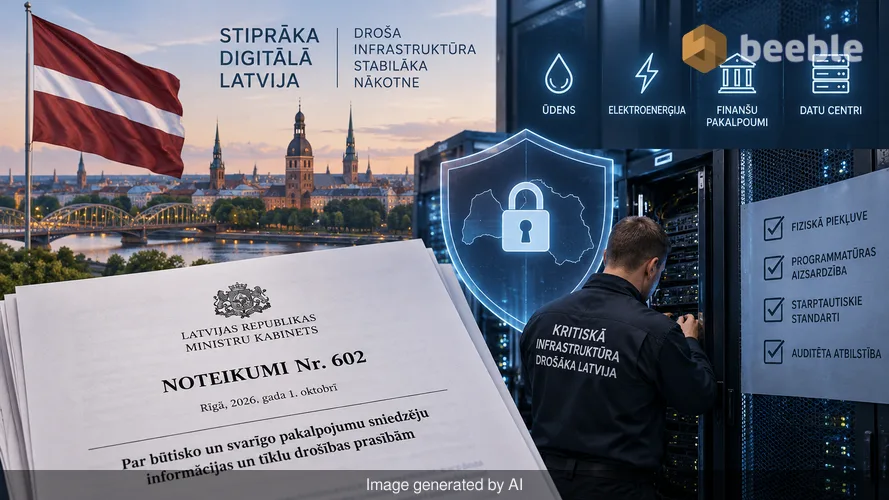
On October 1, 2026, Latvia implemented a set of rules that changes how every byte of critical data moves through the country. The Cabinet of Ministers adopted Regulation No. 602, a document that moves away from the era of voluntary security and toward a period of mandatory, audited safety. This regulation focuses on the physical and digital infrastructure that keeps water running, electricity flowing, and bank accounts accessible. For the average person, this sounds like dry bureaucracy, but it is the digital equivalent of upgrading the locks on every bank vault in the nation simultaneously.
Looking at the big picture, the regulation targets essential and important service providers. These are the companies that manage our most sensitive assets. In the past, a data center could operate with varying levels of oversight. Now, the government requires these facilities to meet strict, international standards. The new rules cover everything from who has physical access to the server racks to how the software defends itself against foreign hackers. It is a fundamental shift in how the state views its digital borders.
The new rules for the digital foundation
Digital infrastructure is the invisible backbone of modern life. When you tap your phone to pay for coffee or check your medical records, you are interacting with a complex web of servers and cables. Historically, this web grew quickly and without a unified set of safety standards. Regulation No. 602 changes this by defining exactly what a secure data center must look like. It applies to owners of critical information and communication technology infrastructure. This includes government agencies, telecommunications giants, and energy providers.
In simple terms, the regulation demands that these entities stop treating security as an afterthought. They must now conduct regular risk assessments. A risk assessment is a formal process where a company identifies every possible way their system could fail. They look at natural disasters, hardware malfunctions, and human error. Once they identify these risks, they must prove they have a plan to stop them. This is no longer a suggestion. It is a legal requirement that carries the weight of state oversight.
The physical requirement for digital safety
A data center is a warehouse for information. Inside these buildings, thousands of hard drives store everything from your private emails to the blueprints for the national power grid. Under the new Latvian rules, these warehouses must be certified. Certification means an independent third party inspects the building and its processes. They check if the cooling systems work during a heatwave and if the backup generators kick in during a blackout. They also verify that only authorized personnel can enter the rooms where the servers sit.
For the average user, this means the services you rely on are less likely to disappear during a crisis. Practically speaking, if a data center has proper certification, it has redundant systems. If one part breaks, another takes over immediately. This redundancy is what keeps your banking app running on a Friday night when everyone else is also trying to use it. The regulation ensures that the physical space where your data lives is as secure as a military installation.
Monitoring the pulse of the network
One of the most significant parts of Regulation No. 602 is the mandate for Security Operations Centers, or SOCs. A SOC is a team of experts who monitor a network 24 hours a day, 7 days a week. They look for unusual patterns that might indicate a cyberattack. Think of it like a high-tech security guard watching a wall of monitors. If a hacker tries to break in at 3:00 AM, the SOC team sees the attempt in real-time and acts to block it.
Before this regulation, only the largest companies could afford a full-scale SOC. Now, essential service providers must have access to these monitoring capabilities. This shift moves the industry from a reactive stance to a proactive one. Instead of fixing a problem after a data breach happens, companies are now looking for the breach before it starts. This constant surveillance is a sturdy defense against the increasing number of automated attacks that target national infrastructure. It turns the digital environment into a place where intruders find it much harder to hide.
Managing the transition to higher standards
The government recognizes that you cannot rebuild an entire industry overnight. While the regulation took effect on October 1, 2026, there is a transitional period that lasts until December 31, 2027. This window allows companies to upgrade their systems without cutting off service to the public. Many existing data centers use older equipment that was not designed with these specific security audits in mind. Replacing or upgrading this hardware takes time and significant investment.
During this transition, companies must map out their path to compliance. They need to hire auditors, perform their first round of risk assessments, and begin the certification process. This period is a grace period, but it is also a deadline. By the start of 2028, any provider that does not meet the standards will face penalties. This clear timeline gives the market predictability. It allows tech companies to budget for these changes and ensures that the transition does not destabilize the economy.
The cost of doing business in a secure environment
Security has a price tag. Building a certified data center costs more than building a standard one. Maintaining a team for a Security Operations Center adds a permanent line item to a company’s budget. These costs are tangible and will likely influence the market. On the market side, we might see smaller service providers merge with larger ones to share the cost of compliance. It is expensive to be secure, and some smaller firms may find the new rules difficult to manage alone.
From a consumer standpoint, this might lead to slight price increases for some digital services. However, this is a trade-off for systemic resilience. If a bank spends more on security, the risk of you losing access to your money due to a hack decreases. Behind the jargon of Regulation No. 602 is a simple economic truth: it is cheaper to prevent a catastrophe than it is to clean one up. The investment made now by these companies protects the long-term stability of the entire digital economy.
How these regulations affect your daily life
Ultimately, this regulation is about trust. We live in a world where we are increasingly dependent on digital systems we cannot see. Most people do not think about where their data goes when they send a message, but that data is moving through physical hardware in a real location. The Latvian government is taking steps to ensure that location is safe. This regulation reduces the likelihood of systemic failures that could disrupt your life.
What this means for you is a higher standard of privacy and reliability. When a company tells you your data is safe, they now have a government-mandated audit to prove it. You should observe your digital habits and notice which providers are transparent about their compliance. As we move toward the 2027 deadline, the companies that embrace these rules will be the ones that earn long-term consumer confidence. This policy is a foundational piece of a modern, resilient society that recognizes digital safety as a basic necessity.
Sources: Cabinet of Ministers of the Republic of Latvia, Ministry of Smart Administration and Regional Development, Official Gazette Latvijas Vēstnesis.



See you on the other side.
Our end-to-end encrypted email and cloud storage solution provides the most powerful means of secure data exchange, ensuring the safety and privacy of your data.
/ Create a free account
