


Your 'Permissionless' Dollar Is Getting a Social Security Number

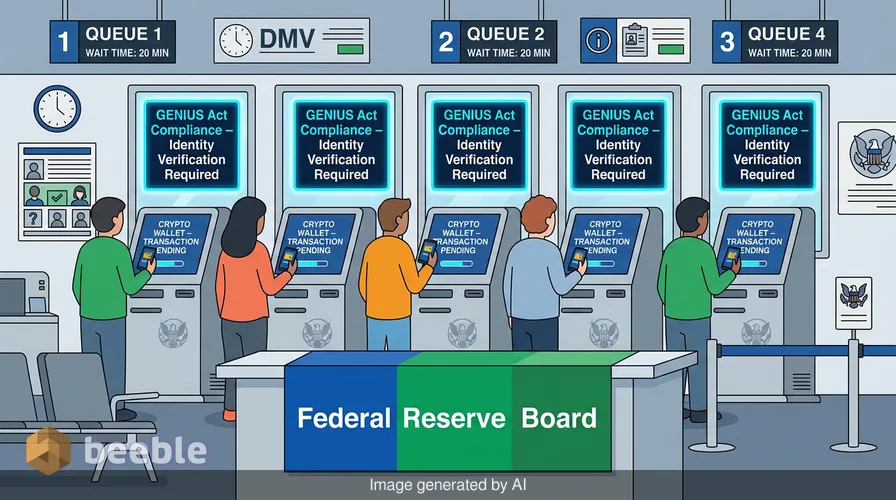
Why does your digital wallet feel like a DMV office lately? You tap a screen. The transaction clears. The fees are low. The speed is high. Then, a pop-up appears. It asks for your passport. It wants your home address. It demands your date of birth. This friction is the first sign of a massive shift in how the United States treats digital money. The era of the anonymous digital dollar is ending.
Federal regulators are now moving to close the gap between your local bank branch and your crypto wallet. On Thursday, the Federal Reserve Board and several other agencies proposed a new rule. This proposal requires stablecoin issuers to verify the identity of every customer. The rule is part of the GENIUS Act framework. It treats stablecoin companies like banks. It forces them to follow the same anti-money laundering laws that govern your checking account. This change is systemic. It reflects a desire to bring the volatile world of crypto into the transparent world of traditional finance.
The digital dollar meets the paper trail
The core of the proposal is the Customer Identification Program, or CIP. This is the same process you go through when you open a credit card or a savings account. You provide your name. You give your address. You share a government identification number. For years, many stablecoin users avoided these steps. They used decentralized platforms to swap assets. They moved money without a middleman. The new rule changes this dynamic for people who interact directly with issuers.
Stablecoins are digital tokens pegged to a stable asset. Most are pegged to the U.S. dollar. They are the plumbing of the crypto world. People use them to buy other coins or to send money across borders. But regulators see a risk. They worry that these tokens allow criminals to move money without detection. The joint proposal from the Fed, FinCEN, the FDIC, the OCC, and the NCUA aims to fix this. It formally classifies permitted payment stablecoin issuers as financial institutions.
This classification is a major step. It brings these companies under the Bank Secrecy Act. This law was written in 1970. It was designed to catch tax evaders and organized crime. Now, it applies to code running on a blockchain. The proposal is 117 pages long. It argues that if a company issues a dollar-equivalent token, that company has a duty to know who is holding it.
The mechanics of the GENIUS Act
The GENIUS Act is the foundation of this new policy. The acronym stands for Guiding and Establishing National Innovation for U.S. Stablecoins. It is a bipartisan effort to create a legal home for digital dollars. Before this law, stablecoin issuers lived in a regulatory gray area. Some were regulated as money transmitters at the state level. Others operated with little oversight.
The act creates two paths for issuers. Large companies with more than $10 billion in tokens must seek federal oversight. Smaller companies can stay under state regulators, provided those states meet federal standards. This proposal ensures that both paths require the same identity checks. Whether an issuer is a giant tech firm or a small state-licensed startup, the rules are the same.
Regulators want a level playing field. They do not want issuers to move to states with weaker rules. NCUA Chairman Kyle Hauptman stated that this proposal mirrors requirements used by credit unions. It sets a single standard for the entire industry. This consistency is essential for a stable financial system.
The line between issuers and users
There is a crucial distinction in the proposed rule. It separates direct relationships from secondary market activity. This is the difference between buying a gift card from a store and finding one on the street.
If you go to a stablecoin issuer to mint new tokens, you must provide your ID. If you go to them to redeem tokens for cash, you must provide your ID. These are formal account relationships. The proposal covers issuance, redemption, custody, and reserve management. In these scenarios, the issuer acts like a bank.
But what if you just hold the coin in your own wallet? What if you send it to a friend? The regulators proposed an exclusion for these activities. Simply holding or transferring a payment stablecoin does not create an account relationship. Secondary market transactions generally do not trigger identity checks for the issuer. This is a practical choice. Issuers often have no way to see who is sending tokens to whom on a public blockchain.
Imagine the blockchain as a glass bank vault. Everyone can see the money moving inside. The public addresses are visible to all. But the names of the owners are not. The government is not trying to put a name on every single address in the vault yet. They are focusing on the doors. They want to know who is putting money in and who is taking it out.
Why regulators want to see inside the vault
This push for identity is about more than just paperwork. It is about the evolution of money. Historically, money was physical. You handed a dollar bill to a cashier. No one asked for your ID. The transaction was private. As we moved to digital payments, that privacy vanished. Every credit card swipe leaves a trail.
Stablecoins promised a return to that cash-like privacy. They offered a way to move value digitally without a central authority watching. This promise created a pervasive tension with the government. Regulators view unmonitored money as a systemic threat. They see it as a tool for sanctions evasion and terror finance.
By requiring identity checks at the point of issuance, the government is reasserting control. They are making the digital dollar look more like the fiat dollar. They are integrating blockchain technology into the existing financial grid. This integration reduces the "wild west" feel of crypto. It also removes some of the freedom that early adopters valued.
The tug of war between states and Washington
There is a political layer to this proposal. A group of senators is fighting to keep states in the driver's seat. On June 16, 2026, Senator Cynthia Lummis led a bipartisan group in a letter to Treasury Secretary Scott Bessent. They asked the Treasury to respect state regulators.
Many states, like Wyoming and New York, already have stablecoin rules. These states want to remain the primary labs for innovation. They worry that federal rules will be too slow or too rigid. The GENIUS Act allows for state certification, but the details are still being worked out.
The new identity proposal shows that the federal government will set the floor. States can add more rules, but they cannot have fewer. This ensures that a digital dollar issued in Cheyenne is just as regulated as one issued in Manhattan. This uniformity is a victory for the large banks. It makes it harder for small crypto firms to compete by offering a more private product.
Rethinking the meaning of financial privacy
On an individual level, this proposal is a reminder that there is no such thing as a free lunch in finance. We enjoy the speed and low cost of stablecoins. We like the idea of 24/7 global markets. But the price of these features is our data.
Financially speaking, the anonymity of cash is a relic. We are moving toward a world where every dollar has a history. This history is stored on a ledger. It is tied to a person. This shift creates a profound change in our relationship with money. We no longer just own an asset; we own a record of our behavior.
Through this economic lens, we see the government's attempt to de-risk the future. They want the benefits of blockchain technology without the risks of decentralization. They want the glass vault to be transparent for them, even if it is opaque for us.
As these rules take effect, you should observe your own habits. Do you value the convenience of a stablecoin enough to share your personal data with a new company? Are you comfortable with a permanent record of your digital transactions? This is the trade-off of the modern economy. We are gaining efficiency, but we are losing the ability to be invisible.
Ultimately, the GENIUS Act and these new CIP rules signal the maturity of the industry. Crypto is no longer a hobby for tech enthusiasts. It is a part of the American financial system. That system requires rules, identity, and oversight. The digital dollar is growing up. It is leaving the playground and heading into the bank.
Sources
Federal Reserve Board, Joint Notice of Proposed Rulemaking on Customer Identification Programs for Stablecoin Issuers (June 2026)
National Credit Union Administration, Chairman Kyle Hauptman's Statement on Stablecoin Integration (June 2026)
U.S. Senate Committee on Banking, Housing, and Urban Affairs, Letter to Treasury Secretary Scott Bessent (June 16, 2026)
Financial Crimes Enforcement Network (FinCEN), Interpretive Guidance on the Bank Secrecy Act and Digital Assets (2026 update)
Guiding and Establishing National Innovation for U.S. Stablecoins (GENIUS) Act, Public Law 119-X



See you on the other side.
Our end-to-end encrypted email and cloud storage solution provides the most powerful means of secure data exchange, ensuring the safety and privacy of your data.
/ Create a free account
