


Europe spent billions on a digital fire alarm that has no batteries

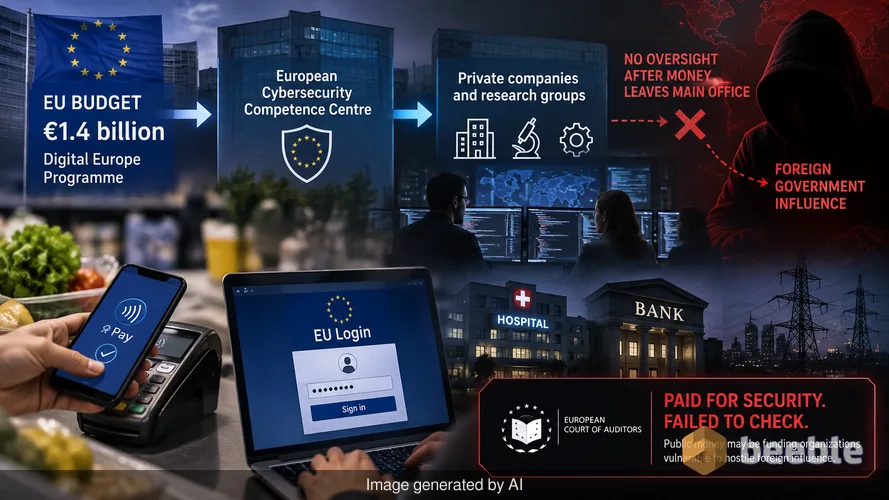
Every time you tap your phone to pay for groceries or log into a government portal, you rely on an invisible network of digital walls. These walls are meant to stop hackers from paralyzing hospitals, stealing bank data, or turning off the power grid. The European Union promised to build a massive, automated alarm system to protect these services. They allocated €1.4 billion to this project through the Digital Europe Programme. This money flows from the central budget to the European Cybersecurity Competence Centre. From there, it travels to private tech companies and research groups that build the software. But a new report from the European Court of Auditors shows that the oversight stopped once the money left the main office.
Behind the jargon, the situation is simple. The EU paid for a high-tech security system but failed to check if the contractors were actually building it or if those contractors had ties to hostile foreign governments. This lack of verification creates a paradox. The very money intended to protect European citizens could be funding organizations that are vulnerable to influence from the states that launch cyberattacks in the first place.
A billion-euro lock with no key
The Digital Europe Programme is the primary channel for cybersecurity spending in the 2021-2027 budget. The goal is to create a robust early-warning network. This network acts as a digital forest fire detection system. If a hospital in Spain is hit by a new type of ransomware, the system should catch the signal and alert a water treatment plant in Germany before the virus spreads. It is a foundational piece of infrastructure for a continent that is increasingly dependent on the cloud.
Roughly 20 months after the project began, the European Court of Auditors found that the system is not operational. It exists on paper and in budget spreadsheets, but the actual sensors and sharing mechanisms are not yet switched on. For the average user, this means the safety net you think is protecting your digital life is currently just a pile of unboxed parts. The auditors examined how well the EU detects and responds to major incidents between 2022 and 2025. Their findings suggest the project is lagging far behind its own deadlines.
The chain of trust has a missing link
To understand why this happened, we must follow the money. When the EU gives a grant to a cybersecurity firm, that firm often hires other smaller companies to do specific tasks. This is standard practice in the tech industry. However, the rules state that the grant recipients must check if their partners are under the control of hostile states. These checks are essential because a company controlled by a foreign intelligence agency could build a back door into the security software.
The European Cybersecurity Competence Centre is the body that oversees these grants. Curiously, the auditors found that this center does not verify the assessments made by the companies. It takes their word for it. In everyday life, this is like a bank giving a mortgage to someone because they wrote "I am very rich" on a sticky note without checking their bank account.
Practically speaking, this means sensitive infrastructure and security-critical technologies are exposed to systemic risks. If a company with hidden ties to a rival power is building the tools that monitor European networks, the shield becomes a window. The auditors are clear about this danger. They state that operational data and infrastructure could be at risk because the check-and-balance system is broken.
Why ownership matters for your digital safety
You might wonder why the ownership of a software company in a distant country affects your personal privacy. In the digital world, hardware and software are the digital crude oil of the modern economy. If the companies that process this oil are opaque, the final product is untrustworthy. A cybersecurity tool has deep access to a computer system. It needs this access to look for viruses. If that tool is compromised, the attacker has the keys to the entire house.
On the market side, this creates a volatile environment for European tech startups. Resilient companies that follow the rules must compete with firms that might have hidden subsidies or different agendas. The lack of transparency makes the entire ecosystem less stable. When the government does not verify who is receiving the funds, it undermines the goal of digital sovereignty. The EU wants to be independent in the tech space, but it is currently writing checks to companies without knowing who really owns them.
The phantom alarm system
The audit also focused on the early-warning network itself. This network is supposed to be the first line of defense against large-scale attacks that cross borders. Historically, cyberattacks were isolated events. Today, they are interconnected. A bug in a single piece of software can crash thousands of businesses at once.
Zooming out, the EU has the ambition to lead in digital regulation, but the implementation is lacking. The €1.4 billion was meant to buy peace of mind. Instead, it bought a series of reports and unfulfilled promises. The auditors noted that the detection system is not ready to handle real-world threats. This delay is not just a bureaucratic headache. It is a tangible vulnerability. While the EU waits for the system to turn on, the frequency and complexity of cyberattacks continue to rise.
From a consumer standpoint, this is a reminder that government-level security is often slower than the threats it tries to stop. The transition from a policy idea to a working tool is often where projects fail. In this case, the failure is twofold: the tool is not ready, and the people building it are not being properly vetted.
What this means for your digital habits
The bottom line is that the "cyber shield" is currently a ghost. You cannot rely on a centralized government system to protect your personal data or your home network in the near term. Since the early-warning system is not functional, the responsibility for basic security remains with the individual and the private service provider.
Looking at the big picture, this audit is a wake-up call for how public money is managed in the tech sector. It proves that throwing money at a problem is not the same as solving it. For the everyday user, the takeaway is to stay skeptical of claims about "impenetrable" national or continental defenses.
Ultimately, you should focus on the variables you can control. Use multi-factor authentication on all sensitive accounts and keep your software updated. Do not wait for a billion-euro shield to protect your data. The most robust defense is still personal digital hygiene. While the EU works on fixing its oversight gaps and turning on its alarm system, your own security habits are the only shield that is currently operational.
Sources: European Court of Auditors Report on EU Cybersecurity detection and response (Sept 2026), Digital Europe Programme budget overview, European Cybersecurity Competence Centre operational guidelines.



See you on the other side.
Our end-to-end encrypted email and cloud storage solution provides the most powerful means of secure data exchange, ensuring the safety and privacy of your data.
/ Create a free account
