


Nearly Half of Europeans Support Banning X Over Repeated EU Law Breaches

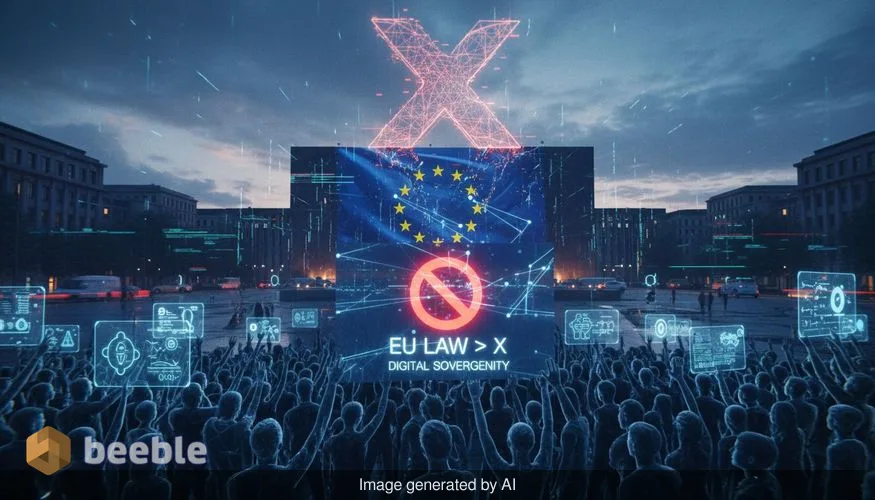
A significant segment of the European public is ready for an extreme regulatory response to the continent’s ongoing battle with Elon Musk’s social media platform, X. A new YouGov survey conducted across five major member states—Germany, France, Spain, Italy, and Poland—reveals that nearly half of all respondents (47 percent) would support banning X from the European Union if it continues to violate EU digital regulations.
This widespread frustration among voters signals strong backing for the European Commission’s assertive enforcement of its landmark Digital Services Act (DSA), a comprehensive set of rules designed to make Very Large Online Platforms (VLOPs) more accountable for the content and systemic risks on their services. Between 60 and 78 percent of respondents in each country believe the EU should take further action, with a majority of those favoring action explicitly supporting a ban if the platform fails to comply.
The DSA’s Clash with X: A Timeline of Non-Compliance
The public opinion poll arrives at a critical juncture, following a period of escalating scrutiny and formal enforcement by the European Commission against X, which has been designated a VLOP due to its size and reach of over 45 million monthly active users in the EU.
The tension began to boil over in late 2023 with the opening of formal infringement proceedings. The investigation centered on X's alleged failure to adequately combat the spread of illegal content and information manipulation.
This formal inquiry led to concrete penalties. In December 2025, the European Commission issued a €120 million fine to X for breaching several key transparency obligations under the DSA.
The Commission’s Decisive Findings Included:
- Deceptive Design of the Blue Checkmark: X’s paid verification system, where anyone can purchase the blue checkmark without meaningful identity verification, was deemed a deceptive design practice. This violates the DSA’s rules against dark patterns and exposes users to scams, impersonation fraud, and manipulation.
- Advertising Transparency Failures: The platform’s advertising repository was found to be insufficiently transparent and accessible, lacking critical information like the legal entity paying for the ad. This hinders the ability of researchers and the public to scrutinize potential information operations and fake advertisements.
- Restricted Researcher Data Access: X was found to have failed its obligation to provide vetted researchers with access to public data, undermining independent analysis of systemic risks within the EU.
Ongoing investigations are also scrutinizing the systemic risks posed by X's recommender systems and the deployment of its built-in AI assistant, Grok, particularly concerning the spread of illegal content like child sexual abuse material and deepfake pornography.
Can the EU Really Ban a Platform Like X?
While the public sentiment is clear—nearly half of Europeans support a ban—the legal reality of the DSA is more nuanced. The legislation does not permit the European Commission to issue a permanent, outright ban on an online platform. Instead, the ultimate sanction is a temporary suspension of the service, an extreme measure of last resort.
The procedure for this temporary restriction is deliberately high-threshold and multi-staged:
- Exhaustion of Remedies: The Commission must first exhaust all other enforcement powers, including imposing the maximum financial penalties, which can be up to 6 percent of the platform’s global annual turnover, or periodic daily penalty payments (up to 5% of average daily turnover).
- Criminal Offense and Serious Harm: The infringement must persist, and be deemed to be causing serious and irreparable harm to users, and entail criminal offenses involving a threat to persons’ life or safety.
- Judicial Process: Only after meeting these strict criteria can the Commission request the Digital Services Coordinator (DSC) in the platform’s Member State of establishment to seek an order from a national judicial authority to temporarily restrict access.
Crucially, this access restriction would not be a direct order to X, but an order addressed to intermediaries like cloud service providers or internet service providers to temporarily block access to the service for users in the EU. This complex legal path highlights that a ban is not a swift political decision but a major judicial and regulatory action reserved for dire, persistent non-compliance that directly threatens public security.
The Takeaway for Platforms and Users
The YouGov poll serves as a powerful political signal to both Brussels and Silicon Valley: the European public has grown weary of regulatory non-compliance. For Very Large Online Platforms, the message is unambiguous:
- DSA Compliance is Non-Negotiable: The transparency obligations—from ad disclosure to data access for researchers—are foundational to the DSA's framework and are being actively enforced. Non-compliance is proven to be an extremely expensive political and financial calculation, as demonstrated by the recent €120 million fine.
- Systemic Risk Mitigation is Key: The most significant ongoing investigations concern the 'systemic risks' posed by algorithms and AI that amplify illegal or harmful content. Platforms must invest in robust content moderation and algorithmic transparency to mitigate these risks, as they are the very conditions that could trigger the ‘temporary suspension’ last resort.
For users, the poll and the Commission's actions affirm that the EU's digital laws are being taken seriously. The goal is a safer digital environment where platform design and advertising are transparent, and where the spread of illegal content is actively curtailed. As the DSA reaches full application, every fine and formal proceeding sets a precedent for how Big Tech operates in the European market.



See you on the other side.
Our end-to-end encrypted email and cloud storage solution provides the most powerful means of secure data exchange, ensuring the safety and privacy of your data.
/ Create a free account
