


Google is offering pennies for the words that power its AI search

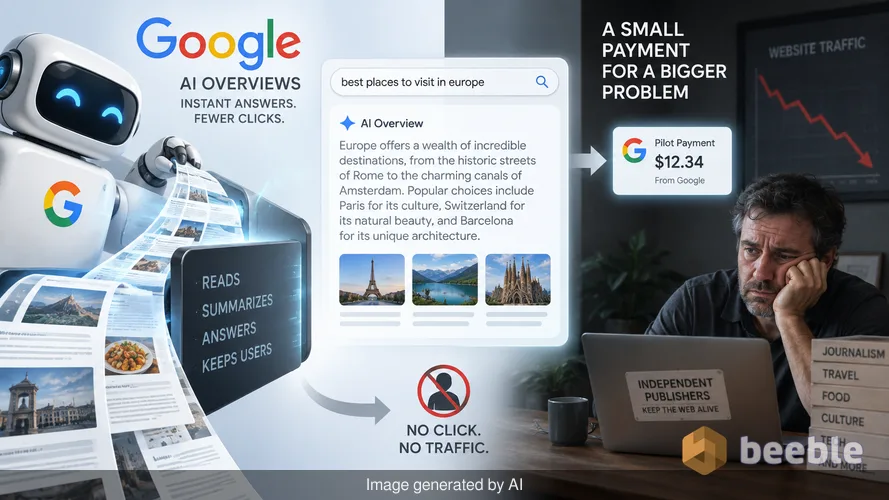
While Google frames its new payment program as a bridge to a new era of search, the reality is a widening gap between what the company takes and what it gives back. The search giant is currently testing a system to pay websites when their content feeds its artificial intelligence, but early data suggests these payments are little more than pocket change for the average publisher. This pilot program, which includes about 100 participants, represents Google's attempt to fix a relationship that AI has effectively broken.
Historically, the deal between Google and the web was simple. Google sent its automated bots to read your site, and in exchange, it sent users to your pages. This traffic turned into ad revenue or sales. AI Overviews have changed this dynamic. Now, the AI reads your site, writes a summary, and gives the answer directly to the user. The user never clicks. The traffic disappears. To keep publishers from blocking its bots, Google has started offering direct payments. However, the scale of these payments is so small that many publishers are questioning if the open web can survive in this new ecosystem.
The math behind the digital blender
Think of Gemini, Google’s AI, as a high-speed digital blender. It takes thousands of articles from different sources, pulverizes them, and pours out a smooth puree of information. The user gets a quick taste, but the individual flavors—the original writers and researchers—are lost in the mix. According to a report from The Information, the financial compensation for this process is underwhelming. Many mid-sized publishers in the pilot program see payments that equal roughly one-tenth of one percent of their usual advertising revenue.
For a website that earns $1 million a year from ads, a 0.1% payment from Google amounts to just $1,000. This is not a replacement for lost traffic. It is a rounding error. These minuscule figures have caused several large media companies to decline the pilot program entirely. These companies believe that by staying out, they can maintain leverage for a more realistic deal. They argue that if Google needs their data to make its AI useful, Google has to pay a price that reflects the cost of producing that data.
A pilot program with tiny payouts
Google has admitted approximately 100 publishers to this experimental group. The criteria for what counts as a material contribution to an AI answer remains opaque. Publishers report that their monthly earnings are unpredictable, making it impossible to budget for the future. One early participant is on track to earn over $1 million per year, which is a significant win for their specific business model. However, this appears to be a rare exception rather than the rule.
More common is the experience of a newer addition to the pilot that earned between $50,000 and $60,000. While that sounds like a decent sum, it is only a small slice of that company's total earnings. Smaller sites are seeing less than $1,000 over several months. This is particularly concerning because these are the very sites that are most vulnerable to traffic drops. If a niche blog loses 30% of its visitors to an AI summary but only gains $200 in compensation, the math simply does not work for long-term survival.
Why some sites earn more than others
Curiously, the payout structure seems to favor specific niches. Publishers in the test noted that topics with strong niche interest but less general competition earn more. Gaming and anime sites have seen better results than general news outlets. This is likely because the AI requires specialized, factual data to answer specific questions about game mechanics or character histories. General news is a commodity; if one site doesn't provide the weather or a political update, a thousand others will.
Behind the jargon of contribution scores and algorithmic weight, the problem is one of transparency. Publishers use a tool called the search console to track their performance, but the data provided for AI contributions is confusing. There is no clear way to see which specific article triggered a payment or how Google calculates the value of a single paragraph. Without this transparency, the program feels less like a partnership and more like a donation.
The search engine that won't let go
Google’s goal is to organize the world’s information, but that information is not a natural resource. It is a product created by people who need to pay rent. If websites stop publishing because they cannot afford to, the AI will eventually have nothing new to learn. This is why the current tension is so systemic. Some publishers are already taking the fight to the courts. A coalition of book publishers has sued over the use of copyrighted material in training models. Penske Media, which owns Variety and Rolling Stone, has sued Google for lost traffic.
Penske Media argues that Google’s current system is unfair because it ties AI scraping to standard web search. Practically speaking, if a website wants to show up in Google’s organic search results, it has to allow Google to scrape its content for AI training. There is no middle ground. This all-or-nothing approach forces publishers to choose between losing their traditional traffic or giving their content away to the AI that will eventually replace that traffic. Looking at the big picture, this is a forced transition that favors the platform over the creator.
Global regulators are losing patience
Government agencies are starting to look under the hood of these AI agreements. The UK government recently ordered Google to provide an opt-out for AI scraping that does not penalize a site’s ranking in regular search results. This is a foundational shift. If publishers can say no to the AI while staying in the search index, Google will have to offer much higher payments to get the data it needs.
The European Commission is also running an antitrust probe. They want to determine if Google is fairly compensating publishers or if it is using its dominant market position to underpay for content. Historically, Google has struggled in EU antitrust cases, often resulting in multi-billion dollar fines. If regulators decide that these 0.1% payments are predatory, Google might be forced to overhaul its entire payment structure globally.
What this means for your daily search
For the average user, this battle might seem like a corporate dispute, but it directly impacts the quality of the information you find online. If the current payment model stays this low, we will see two major changes in the digital landscape. First, more websites will move behind paywalls. If Google won't pay for content, the readers will have to. You will find fewer free articles and more subscription prompts.
Second, the variety of information will shrink. High-quality reporting is expensive. If the financial return for a deep-dive investigation is only a few cents from an AI summary, publishers will stop doing that work. They will switch to cheap, AI-generated filler content to chase whatever pennies are available. The internet could become a feedback loop of low-quality summaries, where the original, human-verified facts are increasingly rare. The bottom line is that the "free" information provided by AI has a hidden cost, and that cost is the health of the sources we rely on every day.
As a consumer, pay attention to the sources cited in your AI summaries. If you find a site that consistently provides the answers you need, visit them directly. The relationship between search engines and creators is shifting, and your clicking habits are one of the few tangible ways to support the publishers that keep the internet useful.
Sources:
The Information, Reuters, UK Competition and Markets Authority, European Commission Antitrust Reports, Penske Media Corporate Statements.



See you on the other side.
Our end-to-end encrypted email and cloud storage solution provides the most powerful means of secure data exchange, ensuring the safety and privacy of your data.
/ Create a free account
