


Why publishers are claiming author paychecks from the Anthropic settlement

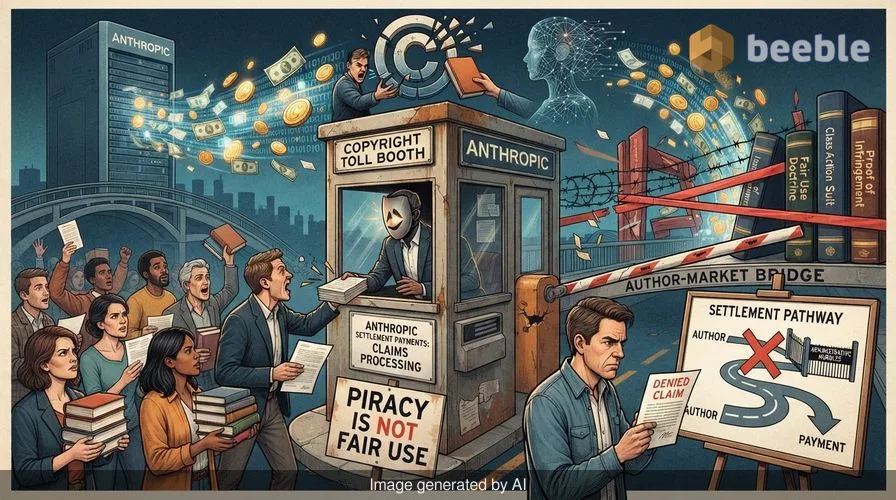
In everyday life, we view a contract as a bridge that connects a creator to a market. Under copyright law, that same bridge sometimes turns into a toll booth where the gatekeeper refuses to leave even after the road is closed. This is the reality for thousands of authors this week as the massive Anthropic settlement payments begin to reach the bank accounts of writers and publishing houses.
The Anthropic settlement is the result of a major copyright class action suit involving the use of books to train artificial intelligence models. While a judge ruled that training AI on copyrighted material is legal under the fair use doctrine, the court found that pirating the source material was a clear violation. As a result, Anthropic agreed to a 1.5 billion dollar settlement. Each pirated work entitles the owner to a three thousand dollar payment. For many authors with backlists of ten or twenty titles, this represents a significant windfall. However, the process of getting that money has become a battlefield.
The math behind the payout split
The settlement terms include a specific formula for how the money is shared. If a book is currently in print with a traditional publisher, the author and the publisher split the three thousand dollars equally. Each party receives fifteen hundred dollars. If the author self-published the book, they receive the full three thousand dollars. The same applies if the book was traditionally published but the rights reverted to the author because the book went out of print.
Rights reversion is a standard contract clause that returns ownership of the work to the author once a publisher stops actively selling it. Once rights revert, the publisher no longer has a legal claim to the income generated by that title. In theory, this rule is clear. In practice, the automated systems used to process these claims are creating chaos for writers who saw their rights return years ago.
The rise of the zombie claims
Authors across social media are reporting what I call zombie claims. These are instances where a publisher makes a claim on a book that they have not owned for years. Mystery writer April Henry recently shared that HarperCollins claimed a book she regained the rights to seventeen years ago. This is not an isolated incident. The blog Writers Beware has received a surge of reports from authors who found their former publishers seeking a full one hundred percent of the settlement payment for books they are only entitled to fifty percent of, or for books they do not own at all.
Victoria Strauss, who tracks publishing industry disputes, suggests that poor recordkeeping is the primary cause. Large publishing houses manage tens of thousands of contracts, and their internal databases often fail to reflect rights reversions that happened decades in the past. When Anthropic opened the settlement portal, many publishers likely uploaded their entire historical catalogs without checking which books they still held the rights to sell.
The download date trap
One specific detail in the settlement text is causing widespread confusion. To claim one hundred percent of a payment, the rights must have reverted to the author before August 10, 2022. This is known as the download date. It represents the moment the copyrighted material was allegedly taken for AI training. If a book went out of print in late 2023, the publisher still has a claim to half of the money because they were the rightsholder at the time of the infringement.
This date creates a heavy backpack for authors to carry. The burden of proof is on the writer to show exactly when their rights returned. If an author does not have the original physical letter or email from their publisher confirming the reversion, they may struggle to dispute a claim. The law treats these contracts as binding documents, and without a paper trail, the default often favors the entity with the larger legal team.
Literary agents and the commission question
Publishers are not the only ones looking for a cut of the settlement. Several literary agencies have also started filing claims for a percentage of the author’s share. This has sparked intense debate within the writing community. A literary agent is a representative, not a rightsholder. While an agent typically receives a commission on book sales and royalties, a legal settlement for copyright infringement is a different category of income.
Author Courtney Milan, a former law professor, has been vocal about this practice. She argues that agents should not be claiming percentages on this settlement. Unless a specific agency contract includes language that covers legal settlements or court awards, the agent may not have a statutory right to the money. This creates a precarious situation for authors who want to maintain a good relationship with their agents but do not want to lose a portion of their settlement to a party that did not suffer the copyright loss.
How to dispute an incorrect claim
If you are an author who received an email stating that a publisher or agent has made a claim on your payment, you have recourse. The settlement process includes a formal dispute mechanism. This is the moment where your records become your shield. You must act quickly to stop the payment from being sent to the wrong party.
First, locate your rights reversion letter. This is the document where the publisher explicitly states they are returning the rights to you. If you cannot find it, you should contact the publisher’s royalty or contracts department immediately to request a copy. Second, gather your original contract. Check the clauses regarding legal settlements and agency commissions. If your contract is silent on these issues, the agency may not have a valid claim.
Third, file the dispute through the official Anthropic settlement portal. You will need to upload your evidence and provide a clear explanation of why the publisher’s claim is null and void. The settlement administrator will then review the conflicting claims. During this time, the money is usually held in escrow, which is a neutral account where funds stay until the dispute is resolved.
The systemic impact of bad data
While industry leaders like Mary Rasenberger of the Authors Guild believe these errors are not malicious, the scale of the problem suggests a systemic failure. When large corporations rely on outdated databases to claim millions of dollars in settlement funds, the individual creator is the one who suffers. The effort required to dispute a three thousand dollar claim is significant, and some authors might decide the stress is not worth the money.
This situation highlights why authors must be diligent about their administrative records. A contract is not just a document you sign once and forget. It is the foundation of your business. Keeping a digital and physical folder for every book, including every amendment and reversion notice, is a fundamental part of a professional writing career. As AI continues to change the legal landscape for creators, these records will only become more robust in their importance.
Steps for authors to take now
If you have titles involved in the Anthropic case, do not wait for a notification to arrive. Take the following steps to protect your share of the settlement:
- Review your list of titles and identify which ones were traditionally published.
- Check the status of those titles as of August 10, 2022.
- Collect all reversion letters for books that are out of print.
- Monitor your email for notices from the settlement administrator or credit alerts that mention new employers.
- Contact the Authors Guild or a similar advocacy group if you encounter a publisher that refuses to fix an obvious error.
Taking these actions ensures that you are not left paying for a publisher's poor recordkeeping. The law is meant to protect the creator, but you must be the one to activate that protection by standing up for your rights.
Sources:
- United States District Court, Northern District of California, Anthropic Copyright Settlement Final Approval Order.
- Authors Guild Statement on AI Training and Fair Use Settlements.
- U.S. Copyright Act, Section 203 (Termination of Transfers and Licenses).
- Fair Labor Standards Act guidelines on independent contractor status.
Disclaimer: This article is for informational and educational purposes only and does not constitute formal legal advice. Laws regarding copyright and contracts vary by jurisdiction and specific contract language. Please consult a qualified attorney in your jurisdiction for advice on your specific legal issues.



See you on the other side.
Our end-to-end encrypted email and cloud storage solution provides the most powerful means of secure data exchange, ensuring the safety and privacy of your data.
/ Create a free account
