


Breakdown: How a Single Unpatched Platform Compromised FBI Operational Security

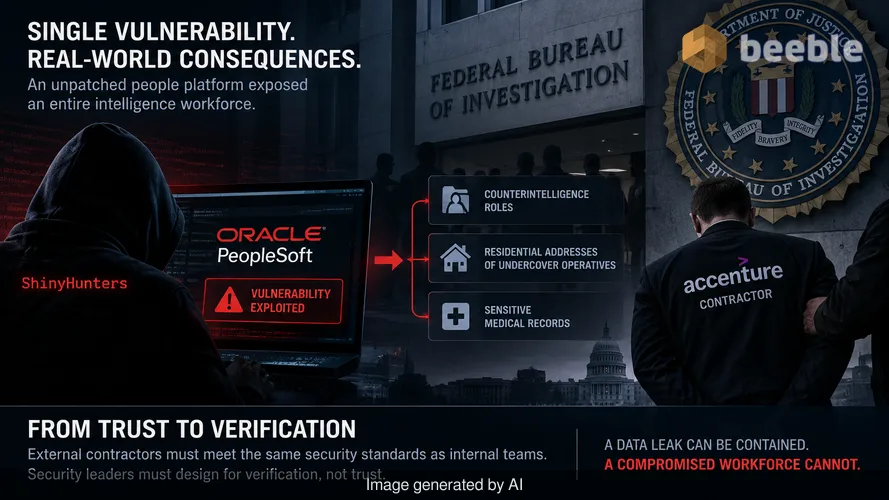
Enterprise infrastructure design relies on the assumption that external contractors maintain the same hygiene standards as the internal security team. This assumption is a structural flaw. The FBI incident proves that a single unpatched human resources platform can compromise an entire intelligence workforce. Security leaders must move from trust-based management to verification-based architecture.
The removal of an Accenture contractor from the Federal Bureau of Investigation follows a catastrophic failure in basic systems hygiene. A vulnerability in Oracle PeopleSoft allowed the threat group ShinyHunters to infiltrate the bureau’s employment portal. This intrusion resulted in the exposure of granular counterintelligence roles, residential addresses of undercover operatives, and sensitive medical records. To gauge the scale, this is not merely a data leak. It is a fundamental compromise of the bureau's physical and operational safety.
The architecture of third-party dependence
The reliance on external vendors for critical human resources functions creates an access asymmetry. Organizations often grant these platforms high-level permissions to manage employee data while offloading the responsibility for software maintenance to the vendor or a third-party contractor. In this instance, the FBI delegated the management of its Oracle PeopleSoft platform to Accenture. This delegation created a blind spot in the bureau's internal security posture.
The platform became a bridge between the public internet and sensitive internal datasets. When a contractor fails to implement a critical patch, that bridge becomes an entry point for lateral movement. The logic shifts to the realization that any system managed by a third party is a high-risk node. It requires the same, if not more, scrutiny as an internally managed asset. The expertise deficit within the contracting workforce acts as an unspoken ally for the attacker.
The collapse of the patch management lifecycle
Oracle issued specific security alerts for PeopleSoft vulnerabilities in June 2026 after Google reported a targeted campaign by ShinyHunters. The contractor failed to act on these alerts. In the current threat environment, patch management on a 'once a month' rhythm is a luxury that no organization can afford. The time-to-exploit window for known vulnerabilities is now measured in days or hours.
ShinyHunters identified the weakness in the job site and utilized it to extract records that should have been isolated. The delay in patching indicates a breakdown in the communication loop between the vendor (Oracle), the manager (Accenture), and the owner (FBI). What this means in practice is that the bureau's security was only as strong as the contractor's weakest administrative link. A failure to apply a single patch rendered millions of dollars in perimeter defense irrelevant.
Data gravity and the blast radius problem
The sensitivity of the compromised data highlights a failure in data minimization and segmentation. The breach exposed counterintelligence job descriptions and psychiatric records. This information has high data gravity; its presence in a single, internet-facing HR platform creates an irresistible target. The blast radius of the PeopleSoft compromise extended far beyond the recruitment portal.
For clarity, a breach of a job application site should never lead to the exposure of medical records or the home addresses of active-duty agents. This indicates that the database architecture lacked the necessary internal barriers to prevent unauthorized data exfiltration. The system treated the contractor's credentials as omnipotent within the platform. Architecture is the only reliable defense against such failures. If the system is unsegmented, a single credential theft or unpatched bug provides the keys to the entire repository.
Tactical metaphors for defensive shifts
An unsegmented legacy system is an open door to any attacker who bypasses the initial lock. In modern security, a DMZ is not a common area, but an individual solitary cell for every application. Each platform must operate in a sandbox where its failure does not impact the broader network ecosystem. The FBI breach illustrates that the traditional perimeter is dead. Internal microsegmentation is the only viable survival strategy for large-scale enterprises.
What exactly needs to be reconsidered is the level of trust granted to management contractors. A service level agreement (SLA) that promises 99% uptime is useless if it does not also mandate a 24-hour patch window for critical vulnerabilities. The business alignment must shift to prioritize security hygiene over operational convenience.
Architectural resilience through microsegmentation
The core of the shift involves treating every platform as a potential breach point. Security teams must implement identity-based microsegmentation for all third-party managed systems. This ensures that even if a contractor fails to patch a vulnerability, the attacker cannot move laterally to more sensitive datasets. Access to medical records should require a separate, higher-assurance authentication flow than access to a recruitment portal.
This incident provides a cold shower for the industry. It demonstrates that the most sophisticated intelligence agencies are vulnerable to basic administrative errors. Proactive defense requires the automation of vulnerability scanning and the enforcement of strict patch timelines. The goal is to reduce the time-to-exploit window to a point where attackers find the effort-to-reward ratio unfavorable.
The CISO action plan for the next twelve months
Security leaders must take immediate steps to audit their third-party dependencies and internal segmentation. The following checklist serves as a pragmatic roadmap to prevent a similar systemic failure.
- Audit third-party patch SLAs: Review all contracts with managed service providers. Mandate a maximum 48-hour window for the application of critical security patches following vendor disclosure.
- Implement data-at-rest encryption with granular keys: Ensure that even if a database is exfiltrated, the data remains unreadable. Different categories of data, such as HR files and medical records, must use different encryption keys.
- Mandate continuous vulnerability scanning: Do not rely on contractor reports. Deploy internal tools to scan third-party managed platforms for known CVEs on a daily basis.
- Enforce microsegmentation: Isolate internet-facing platforms from internal databases. Use a Zero Trust architecture where every request for data is re-authenticated and authorized.
- Revise contractor access protocols: Limit contractor permissions to the absolute minimum required for their specific tasks. Conduct monthly audits of privileged accounts to ensure no credential creep occurs.
- Conduct incident response drills for third-party failures: Simulate a scenario where a contractor-managed platform is fully compromised. Test the organization's ability to contain the breach and protect core assets.
Survival in the current landscape depends on architecture and speed. The objective is not to prevent all breaches, but to ensure that a compromise does not become a catastrophe. Organizations must accept that systems will run behind on patches occasionally. The architectural goal is to make sure their blast radius is the size of a closet, not a warehouse.
Sources
- Federal Bureau of Investigation (FBI) Cyber Division Statement.
- Reuters Investigative Reporting on Accenture and Oracle PeopleSoft.
- Oracle Security Alerts (June 2026).
- Google Cloud Threat Intelligence Reports on ShinyHunters Campaigns.
- CISA Vulnerability Management Guidelines.
Disclaimer: This article is for informational and educational purposes only and does not replace a professional cybersecurity audit or incident response service.



See you on the other side.
Our end-to-end encrypted email and cloud storage solution provides the most powerful means of secure data exchange, ensuring the safety and privacy of your data.
/ Create a free account
