


French retail infrastructure and the cold chain threat: What businesses must prepare for

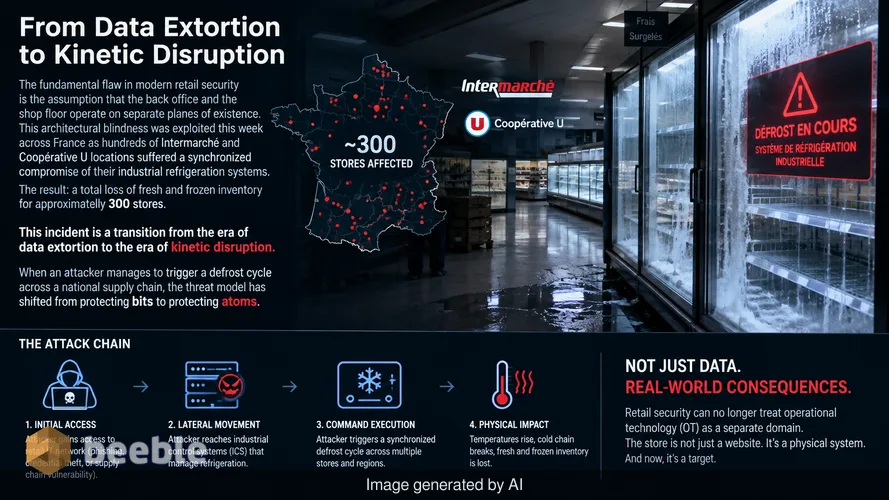
The fundamental flaw in modern retail security is the assumption that the back office and the shop floor operate on separate planes of existence. This architectural blindness was exploited this week across France as hundreds of Intermarché and Coopérative U locations suffered a synchronized compromise of their industrial refrigeration systems. The result is a total loss of fresh and frozen inventory for approximately 300 stores. This incident is a transition from the era of data extortion to the era of kinetic disruption. When an attacker manages to trigger a defrost cycle across a national supply chain, the threat model has shifted from protecting bits to protecting atoms.
The cold chain compromise and the failure of traditional retail defense
The coordinated attack against French supermarkets represents a departure from standard ransomware operations that target enterprise resource planning (ERP) systems or point-of-sale (POS) terminals. In this instance, the adversaries targeted the Building Management Systems (BMS) and Industrial Control Systems (ICS) that regulate the temperature of food storage units. By gaining unauthorized access to the refrigeration controllers, the attackers initiated a defrost cycle, which is a standard maintenance function designed to melt ice build-up on evaporator coils. When triggered maliciously and held in that state, the temperature rises rapidly above safety thresholds.
Intermarché and Coopérative U confirm that the damage is physical and immediate. Fresh produce, dairy, and frozen goods must be discarded to comply with health regulations. The financial impact is twofold: the direct loss of inventory and the operational downtime required to sanitize and restock the facilities. This is a targeted strike on critical food infrastructure. The Paris prosecutor has opened an investigation into this large-scale breach, which also reportedly affected E. Leclerc and potentially Carrefour Market. The speed of the attack suggests a high level of technical proficiency regarding the specific industrial protocols used in retail refrigeration.
The transition from data theft to kinetic disruption
For two decades, the retail sector focused its security spend on PCI-DSS compliance and the protection of customer PII. The logic was simple: keep the credit card data safe to avoid fines and reputational damage. This strategy ignored the inherent vulnerability of the Operational Technology (OT) that keeps the physical business running. Modern refrigeration systems are rarely isolated. They are connected to the corporate network for telemetry, remote maintenance, and energy management. In many cases, these systems are legacy components that lack basic encryption or multi-factor authentication.
To gauge the scale, one must look at the access asymmetry involved. A single compromised technician account or a vulnerable VPN gateway provides a gateway to thousands of IoT devices. The expertise deficit is an unspoken ally for the attacker. Most IT departments do not understand the Modbus or BACnet protocols that these refrigeration units use. Conversely, the contractors who install the refrigeration units are not cybersecurity experts. This creates a security vacuum where critical industrial hardware is exposed to the same lateral movement risks as a standard office workstation.
Why unsegmented legacy is an open door for industrial sabotage
The core of the shift lies in network topology. Traditional enterprise networks often resemble a flat plain where, once a perimeter is breached, an attacker can move freely. If the server that manages supermarket loyalty points is on the same logical network as the system that controls the freezers, a simple phishing email can lead to a national food shortage. A DMZ is not a common area, but an individual solitary cell. Without strict microsegmentation, every connected device is a liability.
In these French incidents, the attackers likely utilized lateral movement to jump from the IT environment into the OT environment. They identified the central management console for the refrigeration units and issued a broadcast command to initiate defrosting. This is not a complex exploit; it is a legitimate use of administrative functions by an illegitimate actor. The vulnerability is the connectivity itself. Retailers have spent years connecting every lightbulb and freezer to the internet to save on electricity costs, yet they have not invested in the architectural isolation required to protect those connections.
The insurance gap and the legal precedent of food waste
Intermarché has already signaled a significant hurdle for the recovery process: insurance limitations. Standard cyber insurance policies often cover data breach notification costs, legal fees, and sometimes ransomware payments. However, many policies contain exclusions for physical property damage or spoilage resulting from a digital event. This creates a massive financial vacuum for the affected franchisees. If the insurance industry does not adapt to the reality of kinetic cyberattacks, the retail sector will face unmanageable risk levels.
What this means in practice is that the C-suite must reconsider cybersecurity as a form of business continuity planning rather than just data protection. The Paris prosecutor’s office is treating this as a threat to the food supply of the French people. This elevation of status from a "corporate breach" to an "attack on critical infrastructure" changes the regulatory landscape. Future audits will likely demand proof of OT isolation. The legal fallout will focus on whether the supermarkets exercised due diligence in securing the systems that maintain public health standards.
Building an architectural blueprint for physical resilience
Survival in this new threat environment requires a transition to a Zero Trust architecture that encompasses every sensor and actuator on the shop floor. The logic shifts to a model where no device is trusted by default, regardless of its location on the internal network. Every refrigeration controller must be isolated within its own microsegment. Communication between the IT network and the OT network must pass through a hardened industrial gateway that performs deep packet inspection to filter out unauthorized commands.
Furthermore, retailers must implement hardware-based MFA for any remote access to building management systems. Relying on simple passwords for systems that control tons of perishable food is an unacceptable risk. The objective is architectural resilience. If an attacker breaches the corporate email system, the blast radius must be contained. The email server and the refrigeration unit should never be able to see each other on the network. This level of granularity is the only way to prevent a localized breach from becoming a national catastrophe.
Action plan for the next twelve months
CISOs and CTOs in the retail and industrial sectors must move beyond reactive patching and toward structural reform. The following checklist provides a pragmatic path for the next year.
- Immediate (0-3 Months): Conduct a comprehensive discovery audit of all OT and IoT devices connected to the corporate WAN. This includes refrigeration, HVAC, lighting, and security cameras. Identify all devices with public-facing IP addresses and move them behind a VPN with MFA immediately.
- Intermediate (3-6 Months): Implement network microsegmentation. Create a dedicated OT VLAN that is physically or logically separated from the guest Wi-Fi and corporate IT environments. Use firewalls to restrict traffic to only necessary protocols (e.g., Modbus, BACnet) and only between authorized endpoints.
- Long-term (6-12 Months): Update procurement contracts to require "Security by Design" for all industrial equipment. Vendors must provide a Bill of Materials (SBOM) and commit to regular firmware updates. Conduct a specialized pentest that focuses specifically on lateral movement from IT to OT systems to validate the segmentation.
- Governance: Review all cyber insurance policies to identify gaps in coverage for physical spoilage and property damage. Negotiate riders that specifically cover kinetic outcomes of digital breaches.
Sources
- Agence France-Presse (AFP) official reports on French retail breaches.
- Paris Prosecutor’s Office public statements regarding infrastructure investigations.
- Intermarché and Coopérative U corporate communications.
- BFM TV technical reporting on E. Leclerc refrigeration incidents.
- ANSSI (French National Cybersecurity Agency) guidelines on OT/ICS security.
Disclaimer: This briefing is for informational and educational purposes only. It does not replace a professional cybersecurity audit, technical assessment, or formal incident response service tailored to specific organizational needs.



See you on the other side.
Our end-to-end encrypted email and cloud storage solution provides the most powerful means of secure data exchange, ensuring the safety and privacy of your data.
/ Create a free account