


How a hidden image processing flaw targeted specific users in the wild

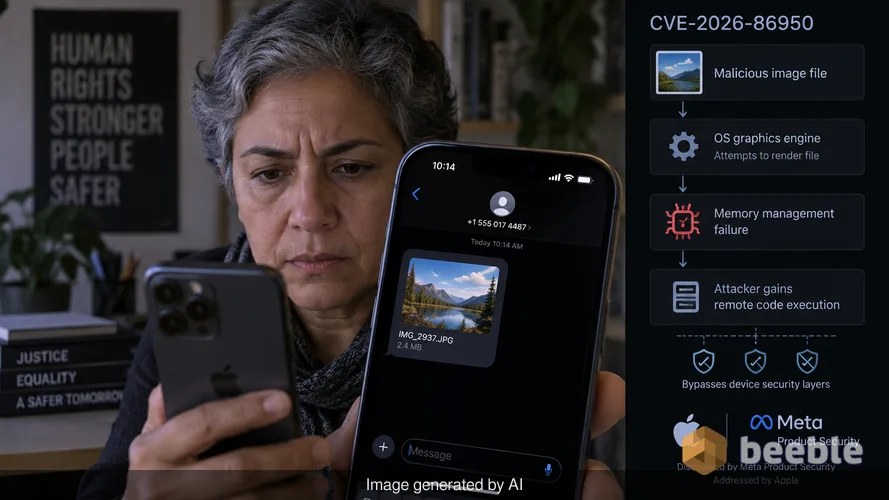
A senior human rights defender receives a seemingly harmless image file through a private messaging app. The device does not crash, and no warning appears on the screen. Behind the user interface, the operating system attempts to render the file using its internal graphics engine. This routine process triggers a silent failure in memory management. The attacker gains the ability to execute code remotely, bypassing the security layers of the device. This scenario describes the likely path for CVE-2026-86950, a vulnerability that Apple recently addressed after reports of its use in highly targeted attacks.
I received word of this flaw through an encrypted channel last week. My contact, a security researcher who works closely with incident response teams, confirmed that the exploitation is not a widespread threat to the average user. Instead, it is a surgical tool used against individuals in specific high-risk professions. This distinction is important for maintaining a calm security posture. A targeted attack requires significant resources and precise execution. Apple acknowledged this reality by describing the exploit as extremely sophisticated. The company credit Meta Product Security with the discovery, which suggests the malicious files may have traveled through platforms like WhatsApp or Instagram where image processing is a constant background task.
The technical anatomy of an out-of-bounds write
The vulnerability exists within CoreGraphics, the framework Apple uses to handle two-dimensional rendering across its entire ecosystem. CoreGraphics is responsible for everything from drawing text to displaying complex PDF files and images. When a program processes a file, it allocates a specific amount of memory for that task. An out-of-bounds write occurs when the system writes data outside the boundaries of this allocated space. This is a classic memory safety failure. If an attacker knows exactly where the data will land, they can overwrite critical system instructions with their own malicious code.
Think of the system memory as a series of strictly labeled storage lockers. CoreGraphics has a key to one locker to store image data. An out-of-bounds write allows the framework to reach over the wall and place items in the adjacent locker, which might belong to a different, more sensitive process. Apple resolved this issue by implementing improved bounds checking. This change ensures the framework verifies the size and destination of every data write before it happens. This simple verification step prevents the memory overflow that leads to arbitrary code execution.
Why targeted attacks prioritize graphics engines
Attackers favor components like CoreGraphics because they are pervasive and often process data before a user even interacts with it. Many messaging apps generate previews of images automatically. This means the vulnerable code runs the moment the file arrives on the device. From a threat actor's perspective, this is a perfect entry point. It requires no active clicks or downloads from the victim. The attack surface is broad because CoreGraphics is a foundational element of the operating system. If you can compromise the rendering engine, you can often compromise the entire application handling that engine.
In my experience analyzing Advanced Persistent Threats (APTs), these vulnerabilities are the most valuable assets in an attacker's toolkit. They are stealthy by design. A user will never see a permission prompt or a suspicious installation window. The breach happens at the architectural level, where the system trusts its own internal frameworks. The sophistication Apple mentions refers to the exploit's ability to remain undetected while achieving persistent access to the target's data.
Assessing the risk for legacy devices
Apple took the unusual step of releasing patches for older versions of its software, including iOS 26 and macOS Tahoe. This decision reflects the severity of the threat. The company is aware that many organizations and individuals continue to use older hardware that cannot run iOS 27. The vulnerability affects a wide range of devices, from the iPhone 11 to the 5th generation iPad mini. On the desktop side, both macOS Tahoe and macOS Sequoia received updates.
This proactive approach to legacy support is a countermeasure against the long lifespan of modern electronics. Security does not end just because a newer model exists. For a corporate fleet manager, this update is mission-critical. A single unpatched device acts as a weak link in the internal network. If an executive uses an older iPad for travel, that device becomes a high-value target for state-sponsored actors or corporate espionage groups. The patch for iOS 26.7.1 and macOS Tahoe 26.7.1 closes a window that has been open for months, if not years.
The pattern of memory corruption in 2026
CVE-2026-86950 is not the first memory-related issue Apple has faced this year. In February, the company patched a flaw in dyld, the dynamic linker, which attackers also weaponized in sophisticated campaigns. That flaw, tracked as CVE-2026-20700, carried a CVSS score of 7.8. The recurrence of these issues suggests that attackers are focusing their efforts on the deepest layers of the Apple ecosystem. They are moving away from the application layer and toward the core libraries that the system uses to boot and render data.
From a risk perspective, this trend shows that the network perimeter is an obsolete concept. If a device can be compromised by a single image file, the security of the local network matters less than the integrity of the device itself. This is why a zero trust architecture is necessary. In a zero trust environment, even a system framework is not implicitly trusted. Every action is verified, and memory is strictly partitioned to prevent one compromised process from affecting the entire system.
Practical steps for immediate mitigation
Patching aside, users in high-risk environments should consider additional layers of defense. If your work involves handling sensitive data or operating in regions with active digital surveillance, the following steps are necessary to minimize your attack surface:
- Enable Lockdown Mode: This Apple-specific feature is designed for individuals who might be targeted by sophisticated cyberattacks. It strictly limits certain functionalities, including complex web technologies and image rendering features, to reduce the ways an attacker can enter the system.
- Disable Automatic Previews: In messaging applications that allow it, turn off the setting that automatically downloads or previews media files. This forces you to choose which files to process, giving you a chance to verify the source before CoreGraphics ever touches the data.
- Audit Legacy Hardware: Identify any devices in your household or organization that are running older operating systems. Ensure they are updated to iOS 26.7.1 or the latest available version for that specific hardware. If a device is too old to receive this patch, it is a toxic asset and you should remove it from the network.
- Reboot Devices Regularly: While many modern exploits are persistent, some reside only in temporary memory. Periodic reboots can clear certain types of malware and force the system to reload its security configurations.
Security is a continuous process of plugging holes in a ship's hull. CVE-2026-86950 represents a significant hole that attackers have already used to board specific vessels. The patch is the only way to seal it. Even if you believe you are not a target, the existence of this exploit in the wild means the code is now known to a wider range of malicious actors. What starts as a targeted attack often becomes a template for broader exploitation later.
Sources
This report relies on security advisories and technical documentation from the following entities:
- Apple Security Releases (September 2026)
- NIST National Vulnerability Database (CVE-2026-86950)
- Meta Product Security Research Blog
- MITRE ATT&CK Framework: Exploitation for Client Execution (T1203)
Disclaimer: This article is for informational and educational purposes only. It does not replace a professional cybersecurity audit, forensic investigation, or incident response service. Always consult with a certified security professional before making changes to enterprise infrastructure.



See you on the other side.
Our end-to-end encrypted email and cloud storage solution provides the most powerful means of secure data exchange, ensuring the safety and privacy of your data.
/ Create a free account
