


How a portal for job seekers exposed the identities of counterespionage agents

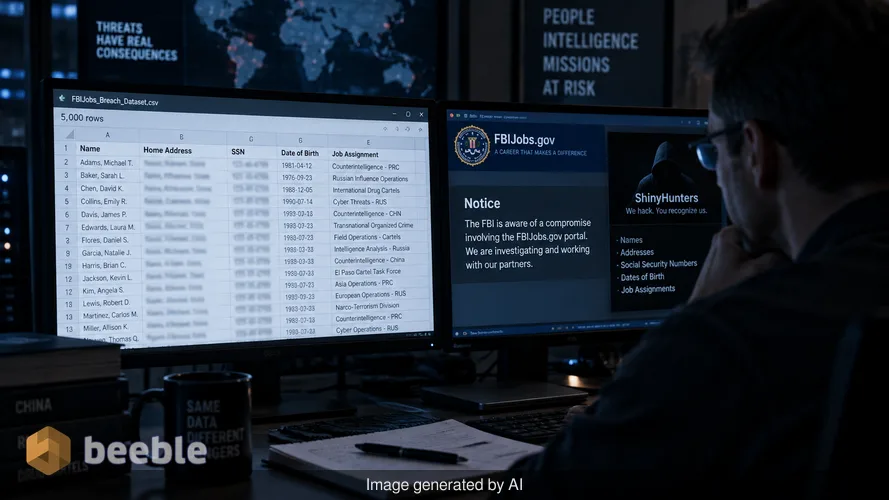
The spreadsheet arrived on my workstation via a secure channel that I monitor for signs of systemic failure in government infrastructure. It is a 5,000-line document that feels heavier than its file size suggests. This data is the result of a breach against the FBIJobs.gov portal, an incident claimed by the hacking group ShinyHunters. While the bureau acknowledges the compromise of the portal, the reality on the ground is far more severe than a simple loss of recruitment data. This leak provides a granular map of the people who work in the shadows of American intelligence.
I spent the morning cross-referencing these entries against known public records and historical breach data. The results are consistent. The spreadsheet contains names, home addresses, Social Security numbers, and dates of birth. Most concerning is the inclusion of specific job assignments. The data identifies individuals assigned to units focused on Chinese spies, Russian intelligence operations, and international drug cartels. For an intelligence officer, this level of exposure is a career-ending event and a significant physical security risk. It transforms their personal information into a toxic asset that threatens their safety and the integrity of their missions.
The anatomy of the ShinyHunters breach
ShinyHunters is a threat actor group with a history of targeting high-profile cloud repositories and web applications. Their methodology usually involves the theft of API keys or the exploitation of misconfigured databases. In this instance, they targeted the FBIJobs.gov portal. This site is a public-facing gateway designed to attract new talent, yet it appears to have held historical and current data on existing employees. The group claims this 5,000-line sample is only a fraction of a larger two-to-three-terabyte trove of stolen data.
The breach occurred because the FBIJobs.gov portal acted as a bridge between the public internet and sensitive personnel records. From a risk perspective, this is a classic failure of network segmentation. Public-facing portals are often managed with less rigor than mission-critical intelligence networks. When a secondary system like a recruitment site has access to a primary database of employee roles, it creates an exploitable path for attackers. ShinyHunters identified this path and used it to bypass the traditional network perimeter that many assume protects federal law enforcement.
Why granular data is a counterintelligence nightmare
In the world of espionage, anonymity is the primary defensive tool. When a hacker leaks the home address and emergency contact of an agent working on the Russian desk, that agent becomes a target for recruitment or physical intimidation. This leak is not a generic data breach. It is a targeted exposure of the bureau’s internal structure. The hackers included details about field office assignments and specific units engaged in high-stakes counterespionage.
I have communicated with source protection contacts who use PGP to discuss the fallout of similar leaks. The consensus is that once this data enters the dark web, it is impossible to retract. Foreign intelligence services do not need to hack the FBI directly if they can simply buy a spreadsheet that identifies every person working in the bureau’s counterintelligence division. The CIA Triad of security relies on confidentiality, and that pillar has been completely compromised for the individuals in this list. The data allows malicious actors to build a comprehensive social graph of FBI personnel and their families.
The psychology of a digital hostage situation
ShinyHunters is not merely interested in selling this data to the highest bidder. They are using it as leverage in a digital hostage situation. The group stated that they are holding the data until the FBI rescinds a specific public statement made in May. This is a form of hacktivism mixed with traditional extortion. By threatening to release more records, they hope to exert pressure on the bureau’s public relations and leadership.
This tactic shows a shift in the threat landscape. Attackers are no longer just looking for credit card numbers. They are looking for reputational damage and the ability to influence government policy. The hackers claimed they are trying to keep the information from circulating widely for now, but this is a hollow promise. In the event of a breach of this magnitude, the data is already in the hands of multiple entities. My analysis of dark web intelligence platforms like District 4 Labs shows that fragments of this data are already being discussed in private forums.
Verifying the unverifiable
Reuters was able to verify the identities of 22 people in the spreadsheet by comparing the leaked data with credit records. My own forensic analysis of the file structure suggests it was exported directly from a relational database. The fields are organized in a way that mirrors professional HR management software. There are no signs of the typical data fabrication seen in smaller, low-effort scams. The presence of emergency contact details is particularly telling, as this information is rarely found in public records.
Behind the scenes, the FBI is investigating the cause of the breach. They have categorized ShinyHunters as a cyber-criminal enterprise. This designation is accurate, but it does little to mitigate the immediate danger to the agents whose lives are now documented in a searchable CSV file. The bureau’s statement that the cause is undetermined suggests that the forensic team is still tracing the initial point of entry. It is likely they will find a compromised credential or an unpatched vulnerability in the portal’s web framework.
Lessons from the human firewall failure
Every security professional talks about the human firewall, but this incident shows that even the most trained individuals are vulnerable if the systems they use are flawed. The employees did not do anything wrong. They provided their information to their employer with the expectation of privacy. The failure is architectural. A recruitment portal should never have a direct or indirect link to the granular job assignments of active intelligence officers.
Organizations must treat employee data as a mission-critical asset. If your network perimeter is an obsolete concept, you must rely on Zero Trust principles. In a Zero Trust environment, the recruitment portal would be treated as an untrusted guest. It would have no way to query the database that holds the Social Security numbers of the counterespionage team. Instead, the bureau appears to have used a flat data structure where a breach in one area leads to a total loss of confidentiality across the board.
Practical takeaways for security leaders
This incident provides a stark reminder that your most sensitive data often hides in the least expected places. Security leaders should take the following steps to prevent a similar catastrophe:
- Audit all public-facing portals and secondary websites to ensure they do not have access to primary personnel databases.
- Enforce strict data minimization policies. If a system does not need a Social Security number to function, that data should not be stored there.
- Implement granular access controls that prevent HR data from being exported in bulk without multiple layers of authorization.
- Monitor the dark web for mentions of your organization’s specific internal jargon or department names, as these are often the first signs of a targeted leak.
Securing the future of personnel data
The FBI now faces the monumental task of protecting its employees from the consequences of this exposure. This will likely involve identity monitoring, relocation for certain high-risk individuals, and a complete overhaul of how the bureau manages its public web presence. The damage to the bureau’s reputation is significant, but the danger to its human assets is the real story. We must stop viewing data breaches as a cost of doing business and start viewing them as a direct threat to national security.
Sources: NIST Special Publication 800-53, MITRE ATT&CK Framework (Cloud Matrix), Reuters investigative report, District 4 Labs intelligence brief.
Disclaimer: This article is for informational and educational purposes only and does not replace a professional cybersecurity audit or incident response service.



See you on the other side.
Our end-to-end encrypted email and cloud storage solution provides the most powerful means of secure data exchange, ensuring the safety and privacy of your data.
/ Create a free account
