


How an optional SNMP package opened a backdoor into global mail servers

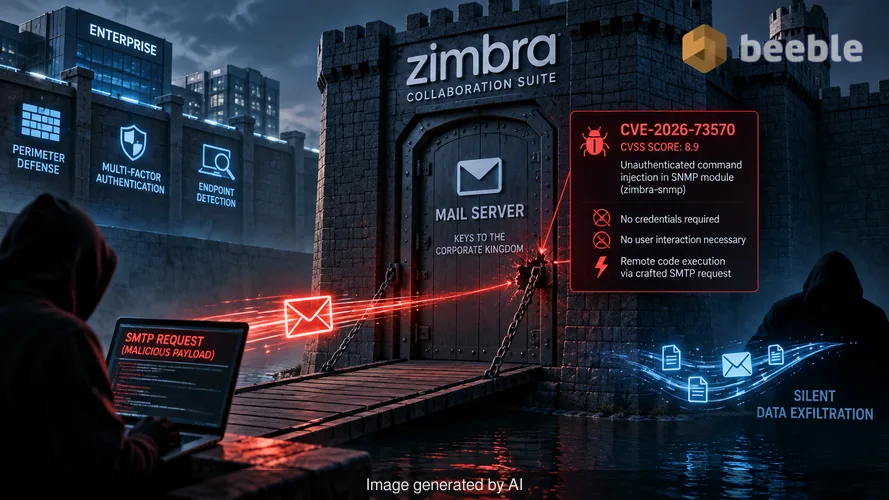
Enterprises spend millions of dollars on perimeter defense, multi-factor authentication, and sophisticated endpoint detection. They treat the mail server as a fortified vault because it contains the keys to the corporate kingdom. However, a single unauthenticated command injection flaw in an optional component recently proved that even the most expensive digital moat fails when the drawbridge has a faulty latch. This is the architectural paradox of modern mail security. A system designed to facilitate communication becomes the primary vector for silent data exfiltration because of one neglected package.
Microsoft Security Research recently identified a campaign targeting Zimbra Collaboration Suite (ZCS) instances. The attackers weaponized CVE-2026-73570, a vulnerability with a CVSS score of 8.9. This flaw exists within the Simple Network Management Protocol (SNMP) notification module. When a server has the zimbra-snmp package installed, an attacker can send a specially crafted SMTP request to trigger remote code execution. No credentials are required. No user interaction is necessary. The server simply processes the email and hands over control to the adversary.
The mechanism of a silent injection
Behind the scenes, the vulnerability stems from how Zimbra handles SNMP notifications. Simple Network Management Protocol is an industry standard for monitoring network-attached devices, but in this context, it acts as a digital Trojan horse. The flaw allows an attacker to inject operating system commands through the mail delivery process. By sending a malicious SMTP message, the actor forces the Zimbra service to execute arbitrary code with the privileges of the zimbra account.
I reviewed the exploit chain with a trusted source over a PGP-encrypted Signal thread last week. The simplicity of the execution is what makes it so dangerous. At the architectural level, the mail server expects the SMTP protocol to strictly handle message routing. It does not expect that message to interact with the underlying OS management tools. When the zimbra-snmp package is active, the boundary between the application layer and the operating system dissolves. Consequently, an attacker gains an immediate foothold without needing to bypass a single password prompt or phishing a single employee.
A race against the disclosure clock
Timing is everything in threat intelligence. Zimbra released a patch for this flaw in version 10.1.20 on July 20, 2026. However, public disclosure did not occur until August 13, 2026. Microsoft identified a surge in activity during this specific interval. Between July 28 and August 7, two separate scanning tools began probing the injection path. These were not random attempts. They were precise, out-of-band validations to see which servers were vulnerable before the full exploit began.
This behavior highlights a reactive reality for many IT departments. Attackers often monitor patch releases and perform differential analysis on the code to find the fixed vulnerability. They find the hole before the public is even aware that a hole existed. In this case, the attackers had a three-week window to operate in the shadows. By the time the U.S. Cybersecurity and Infrastructure Security Agency (CISA) added the flaw to its Known Exploited Vulnerabilities catalog, the damage was already done for many organizations.
Redundancy and persistence in the mailbox
Following successful exploitation, the attackers did not just take a few files and leave. They built a home. Microsoft observed the deployment of JSP web shells across both Jetty and mailboxd application paths. Using multiple paths is a common strategy for redundancy. If a security admin finds one shell in a standard directory, they might stop looking, while the second shell remains active in a less obvious path.
From a risk perspective, these web shells provide persistent remote access. The actors used these shells to escalate privileges and download additional malicious payloads via curl or wget. They also established interactive reverse shells, which allow them to type commands directly into the compromised server. The goal was clear: total control over the mail environment. They accessed mailbox data, collected authentication secrets, and created archives of sensitive communications for later transfer. This level of access compromises the entire CIA triad, as confidentiality, integrity, and availability are all lost to the attacker.
The human firewall and the limit of automation
We often talk about the human firewall as the primary defense against phishing, but technical flaws like CVE-2026-73570 remove the human from the equation entirely. An administrator could have the most security-conscious staff in the world, yet the server would still fall because of a background monitoring package. This is why a zero trust architecture is necessary. If the internal mail service is treated like a VIP club bouncer treats a guest—never trusting, always verifying—the lateral movement after an initial compromise is much harder.
Proactively speaking, the zimbra-snmp package is an example of the dark matter of the corporate network. It is an optional component that many admins might not even know is running. If a package is not essential for daily operations, it should be removed to reduce the attack surface. Every extra line of code and every optional utility is a potential entry point for a persistent threat actor. A resilient security posture requires knowing exactly what is installed and why it is there.
Practical steps for recovery and hardening
If you manage a Zimbra environment, patching is only the first step. Because this flaw was exploited in the wild before public disclosure, a clean patch does not guarantee a clean server. You must assume that an attacker may have already established a presence. Forensic analysis of the environment is the only way to ensure data integrity.
Start by reviewing the "/var/log/zimbra.log" file. Look for unexpected restarts of Zimbra services, as the exploit often triggers a crash or a manual restart by the attacker to stabilize their shells. Search for new or modified JSP files in the webapps directories of Jetty and mailboxd. These files often have random names or mimic legitimate system files to avoid detection.
Beyond the immediate cleanup, consider the following actions:
- Audit all installed Zimbra packages and remove zimbra-snmp if SNMP monitoring is not a mission-critical requirement.
- Implement network segmentation to ensure that the mail server cannot initiate outbound connections to arbitrary IP addresses.
- Enforce granular logging for all command-line activities associated with the zimbra service account.
- Conduct a full credential reset for all administrative accounts, as authentication secrets were a primary target during the observed attacks.
The threat landscape is increasingly filled with actors who wait for the gap between a patch and a public advisory. If your vulnerability management program only reacts to news headlines, you are already behind. Real security happens in the quiet moments between disclosures, where you audit your configurations and remove the unnecessary tools that attackers love to exploit.
Sources
- Microsoft Security Research Report on Zimbra Exploitation
- CERT Polska Security Advisory for CVE-2026-73570
- CISA Known Exploited Vulnerabilities Catalog
- Zimbra Collaboration Suite Version 10.1.20 Release Notes
- MITRE ATT&CK Framework: T1190 (Exploit Public-Facing Application) and T1505.003 (Web Shell)
Disclaimer: This article is for informational and educational purposes only and does not replace a professional cybersecurity audit or incident response service.



See you on the other side.
Our end-to-end encrypted email and cloud storage solution provides the most powerful means of secure data exchange, ensuring the safety and privacy of your data.
/ Create a free account
