


Securing your cloud budget against the x47.c denial of wallet attack

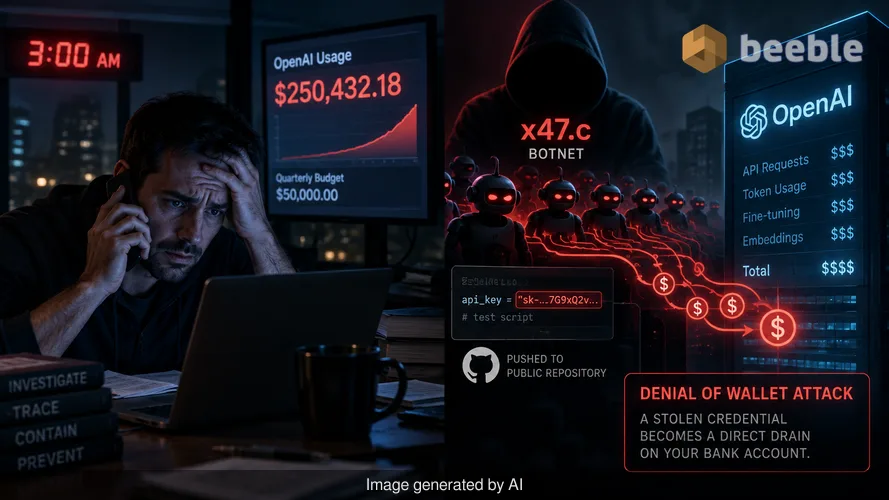
I remember a call I received at 3:00 AM two years ago from a panicked CTO. His company had just launched a new generative AI feature, and within six hours, their OpenAI usage bill surpassed the quarterly budget. We spent the next four hours tracing the leak to a hardcoded API key in a test script that a developer accidentally pushed to a public repository. The incident was a manual error, but today, threat actors automate this financial devastation. The x47.c botnet is the latest tool in this category. It turns a stolen credential into a direct drain on a company's bank account through a method known as a denial of wallet attack.
The paradox of modern security is that an organization can spend five figures monthly on a top-tier web application firewall while leaving a million-dollar credit line exposed through a single text string. An attacker does not need to breach your network if they can simply impersonate your application to a third-party service provider. This is the architectural flaw that x47.c exploits. It ignores the traditional network perimeter and targets the financial integration between your business and your AI provider.
The mechanics of the api credit drain
Qrator Research Labs recently documented the capabilities of x47.c, a Windows-based botnet marketed by a seller named WraithTools. The most distinctive feature is the AI API drain command. This module targets valid API keys for OpenAI, xAI, and other compatible chat services. Once the botnet acquires a key, it sends a continuous stream of billable requests directly to the AI provider. Because these requests originate from the botnet and go straight to the provider, your local security stack never sees the traffic.
This bypass renders traditional rate limiting on your own website useless. A denial of wallet attack differs from a standard denial of service because its primary goal is not to crash a server, but to exhaust a financial resource. If your account has automatic top-ups enabled, the botnet can continue to accrue charges until your credit card reaches its limit or the bank freezes the account. The seller specifically markets this as a service to use against competitors. A business that relies on AI-driven chatbots or trading bots can find its operations halted when the AI provider suspends the account due to unpaid balances.
How grok assists in malware persistence
The x47.c botnet also uses artificial intelligence to protect itself from removal. The malware includes an AI Stealth module that utilizes xAI’s Grok model to evaluate the environment of the infected host. After the malware gains a foothold, it analyzes the system settings and security software present on the machine. It then selects the most effective persistence and concealment actions from a predefined list. This allows the malware to adapt its behavior to the specific defenses of the victim.
If the botnet detects Windows Defender, the AI module can attempt to create exclusions. If the connection to the Grok model fails, the malware falls back to local, hardcoded persistence routines. This use of AI for defensive evasion represents a shift in the threat landscape. Instead of relying on a static script that an antivirus engine can easily flag, the malware uses a large language model to make decisions in real time. This increases the chances that the bot remains active on the host for an extended period.
The eighteen methods of disruption
Beyond the AI-specific features, x47.c is a comprehensive tool for distributed denial of service attacks. It offers eighteen different attack methods. These include standard volumetric attacks like TCP and UDP floods, as well as more sophisticated layer seven attacks like HTTP floods and slow HTTP connections. The botnet also includes modules for TLS connection stress and reflection techniques that amplify the volume of traffic sent to a target.
Qrator noted that the seller claims these methods can bypass common DDoS protections, though no independent test results currently verify these claims. In my experience, these types of advertised bypasses often rely on the fact that many organizations misconfigure their protection layers. A DDoS attack is often a distraction for a secondary goal, such as data exfiltration or credential theft. While the security team is busy mitigating a flood of traffic, the botnet's stealer module can quietly harvest browser passwords and cookies.
The proxy economy and credential theft
The x47.c botnet serves as a multi-purpose toolkit for the modern attacker. It includes a SOCKS5 proxy module that turns every infected machine into a relay for malicious traffic. An attacker can route their activities through the victim's network, making the traffic appear legitimate. This is a common tactic for bypassing geo-blocking or IP-based reputation filters. If an attacker uses your office IP address to launch an attack on another company, your organization may face legal or reputational consequences.
From a data integrity perspective, the stealer module is a significant risk. It targets browser passwords, cookies, and Discord tokens. While the current documentation for x47.c does not show an automated pipeline that turns these stolen tokens into API keys for the drain command, the capability is inherent. An attacker who steals a session cookie for a cloud console can manually generate the API keys required to initiate a denial of wallet attack. The malware is priced between $200 and $950 depending on the package. This low barrier to entry means that even low-skilled actors can launch attacks that cause massive financial damage.
Practical defense for the ai era
Protecting against a botnet like x47.c requires a shift in how we think about the attack surface. We must treat API keys with the same level of care as administrative passwords or private encryption keys. A reactive approach to security is no longer sufficient when a botnet can spend thousands of dollars in a single hour. You must be proactive in your defense.
Start by auditing every location where you store AI API keys. They should never appear in client-side code, public repositories, or unencrypted configuration files. Use environment variables or dedicated secret management services like HashiCorp Vault or AWS Secrets Manager. If a key is ever exposed, revoke it immediately and generate a new one. The simple act of rotation can stop a denial of wallet attack in its tracks.
Next, implement granular controls at the provider level. Most AI services allow you to set monthly spending limits and usage quotas. You should disable automatic top-ups unless they are absolutely necessary for mission-critical operations. Setting a hard cap on your spending ensures that even if a key is compromised, your total loss is limited to a predictable amount. Monitoring is equally important. You should set up alerts that trigger when usage exceeds a certain percentage of your daily average. If you see a spike in API calls that does not correlate with legitimate user activity, you may be under attack.
Finally, maintain a resilient endpoint security posture. The AI-assisted persistence of x47.c is effective, but it still relies on gaining initial access to the machine. Enforce the principle of least privilege and ensure that all systems are fully patched. A robust endpoint detection and response system can often identify the anomalous behavior of a botnet even if the malware uses AI to hide its persistence mechanisms. Security is not a one-time setup. It is a continuous process of verification.
Sources
- Qrator Research Labs: Technical analysis of the x47.c botnet and WraithTools documentation.
- OWASP: Definition and mitigation strategies for Denial of Wallet (DoW) attacks.
- NIST Special Publication 800-207: Principles of Zero Trust Architecture regarding resource access.
- MITRE ATT&CK: Framework for understanding botnet persistence and DDoS techniques.
Disclaimer
This article is for informational and educational purposes only. The information provided does not replace a professional cybersecurity audit, incident response service, or legal advice regarding data breaches. Always consult with a qualified security professional before making changes to your infrastructure.



See you on the other side.
Our end-to-end encrypted email and cloud storage solution provides the most powerful means of secure data exchange, ensuring the safety and privacy of your data.
/ Create a free account
