


The third-party shortcut that exposed eight million Danish identities

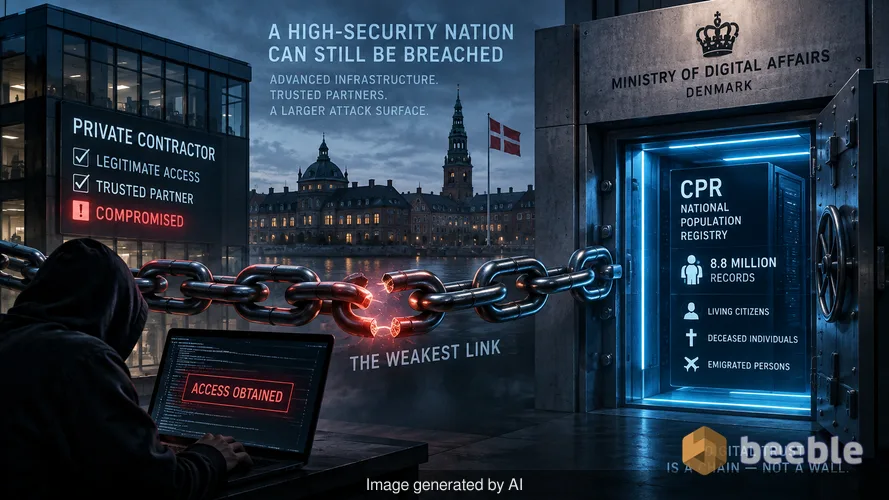
A high-security vault is only as strong as the key held by the janitor. On Monday, the Danish Ministry of Digital Affairs confirmed that unauthorized individuals accessed the national population registry, a database known as the CPR. The breach is a systemic failure that affects 8.8 million people. This number is startling because Denmark has a population of only six million. The data includes records for the deceased and those who emigrated years ago. Christina Egelund, the Digital Affairs Minister, labeled the event an extremely serious incident. The investigation is in its early stages, but the method of entry is clear. Attackers did not breach the government infrastructure directly. Instead, they compromised a private Danish company that held legitimate, legal access to the registry.
This incident is a textbook example of an architectural paradox. Denmark is one of the most digitized nations on earth. The government invests millions in secure infrastructure and resilient frameworks. However, the system relies on a decentralized web of private contractors to function. When one of these contractors fails to maintain a robust defense, the entire national database becomes an exploitable asset. From a risk perspective, this is a supply chain catastrophe. The hackers found the weakest link in a chain of trust and used it to walk past every firewall the government had in place.
The architecture of a national identity crisis
The CPR registry is the backbone of Danish life. It contains names, addresses, and social security numbers. In Denmark, this number is a universal key. It is required for healthcare, banking, employment, and tax filings. When 8.8 million of these numbers are compromised, the threat actor gains the ability to impersonate nearly every citizen and former resident of the country. This is not a simple leak of email addresses. It is the theft of permanent, unchangeable identity markers.
Behind the scenes, the Ministry of Digital Affairs is mapping the extent of the unauthorized access. The hackers entered through a company that provides services requiring registry data. At the architectural level, this type of access is often granted through an API or a dedicated portal. If the company does not enforce stringent access controls, a single compromised employee account provides a path to millions of records. This is zero trust as a VIP club bouncer at every internal door, but in this case, the bouncer was asleep at the side entrance. The government has not yet revoked the company’s access, which suggests they are still attempting to identify the specific vulnerability or are maintaining the connection to monitor ongoing malicious activity.
Why the number of victims exceeds the population
Many citizens were confused by the figure of 8.8 million. If the country has six million people, the scale of the breach seems impossible. The registry is a historical ledger. It keeps data on everyone who has ever lived in Denmark or held a residency permit. Consequently, the data pool is massive. For a hacker, this is a gold mine. Deceased individuals are prime targets for identity fraud because their records are rarely monitored for new activity. Emigrants are similarly vulnerable. They may not check Danish credit reports or government portals for years, giving attackers a stealthy way to open accounts or launder money using legitimate identities.
I recently consulted with a forensic analyst who deals with similar registry breaches. He noted that hackers prioritize these large, historical datasets because the information is evergreen. An address might change, but a CPR number remains static for life. From an end-user perspective, this is a permanent increase in the personal attack surface. Once this data is on the dark web, it stays there. There is no password reset for a national identity number. The confidentiality of the CIA Triad has been fundamentally broken for a significant portion of the European population.
The danger of the third-party shortcut
Organizations often treat third-party vendors as an extension of their own secure perimeter. This is a mistake. In terms of data integrity, you are only as secure as the least secure vendor in your stack. This Danish company was a trusted partner. It had a legal mandate to access the registry. This legal access became a digital Trojan horse. Attackers look for these mid-market firms because they often lack the forensic capabilities or the 24/7 SOC monitoring of a national government.
Assessing the attack surface of a government entity must include every external entity with a login. Proactively speaking, a registry of this importance should require granular access. There is rarely a reason for a single private firm to have the ability to pull records for 8.8 million people. If the company only services a specific region or demographic, its access should reflect that limitation. This incident demonstrates that Denmark granted broad, systemic access to a firm that could not defend it.
Tactical advice for organizations and citizens
If you operate a business that relies on third-party data access, you must audit your permissions immediately. Do not wait for a breach notification to realize a vendor has more access than they require. Patching aside, the most effective defense is the principle of least privilege. If a partner only needs to verify one thousand records a month, do not give them an open pipe to your entire database.
For the individuals affected in Denmark, the situation requires reactive measures. The government has not yet identified the perpetrators, but the data is likely already in the hands of brokers.
- Monitor your MitID and NemID logs for unauthorized login attempts.
- Enable credit alerts through your bank to catch any new accounts opened in your name.
- Be skeptical of any phone calls or emails that use your CPR number to verify your identity; hackers use this information to build trust during social engineering attacks.
- Use a password manager and unique passwords for every service to prevent credential stuffing attacks if other data was stolen alongside the CPR numbers.
The path toward systemic resilience
This breach is a reminder that data is a toxic asset. The more of it you hold, the higher the risk to your organization. Denmark’s digital ministry is now in the difficult position of trying to secure a barn door after the horse has bolted. The investigation will eventually reveal if the company used multi-factor authentication or if they left a database exposed to the public internet. Regardless of the technical root cause, the systemic failure is the lack of oversight on third-party entry points.
We must move toward a decentralized identity model where the government does not need to hand over bulk files to private firms. Technologies like zero-knowledge proofs could allow a company to verify a citizen's age or residency without ever seeing or storing their CPR number. Until such systems are mission-critical, we will see a repeat of this incident. The Danish government must now decide if the convenience of third-party integration is worth the total compromise of its citizens' privacy.
Key takeaways for IT leaders
- Conduct a comprehensive audit of all third-party API keys and access portals.
- Implement mandatory multi-factor authentication for every vendor account without exception.
- Review data retention policies to ensure you are not storing records for people who no longer use your services.
- Enforce granular access controls so that a breach at a partner firm is contained to a small subset of data.
- Build an incident response plan that specifically addresses supply chain compromises.
Sources:
- NIST Special Publication 800-161 (Supply Chain Risk Management)
- Danish Ministry of Digital Affairs Press Release (Oct 2026)
- MITRE ATT&CK Framework: Trusted Relationship (T1199)
- GDPR Article 32: Security of Processing
Disclaimer: This article is for informational and educational purposes only and does not replace a professional cybersecurity audit or incident response service.



See you on the other side.
Our end-to-end encrypted email and cloud storage solution provides the most powerful means of secure data exchange, ensuring the safety and privacy of your data.
/ Create a free account
